University project · Driver assistance
Why is testing driver-assistance systems so slow?
Realistic simulations take longer and longer to compute, and they also have to model how drivers behave. A systematic literature review.
Auf einen Blick
- Type
- Systematic literature review, not published
- Period
- 2022
- Topic
- Advanced driver-assistance systems (ADAS)
- Method
- Kitchenham and Charters guidelines, Scopus
Hintergrund
A research paper for the Research and Development Project module of the master's programme Technology and Innovation Management at Hochschule Harz, written with a fellow student in the Department of Automation and Computer Science.
Why simulate at all
Most new cars already help their drivers. They brake on their own when someone steps onto the road, keep the car in its lane, hold the distance to the car in front, and beep when you reverse towards a wall. These are advanced driver-assistance systems, or ADAS.
Each of them has to be proven safe before it goes on sale, and here road testing alone runs into a wall. A 2016 RAND study estimated that self-driving cars would need hundreds of millions of miles, sometimes hundreds of billions, to prove they are safer than human drivers. Even large test fleets would need tens or hundreds of years to drive that far. Driver assistance is a smaller step than full self-driving, but the problem is the same: the dangerous moments are rare, so you cannot simply wait for them on a real road.
That is why so much testing moves into the computer, where a near-miss in fog can be repeated a thousand times overnight.
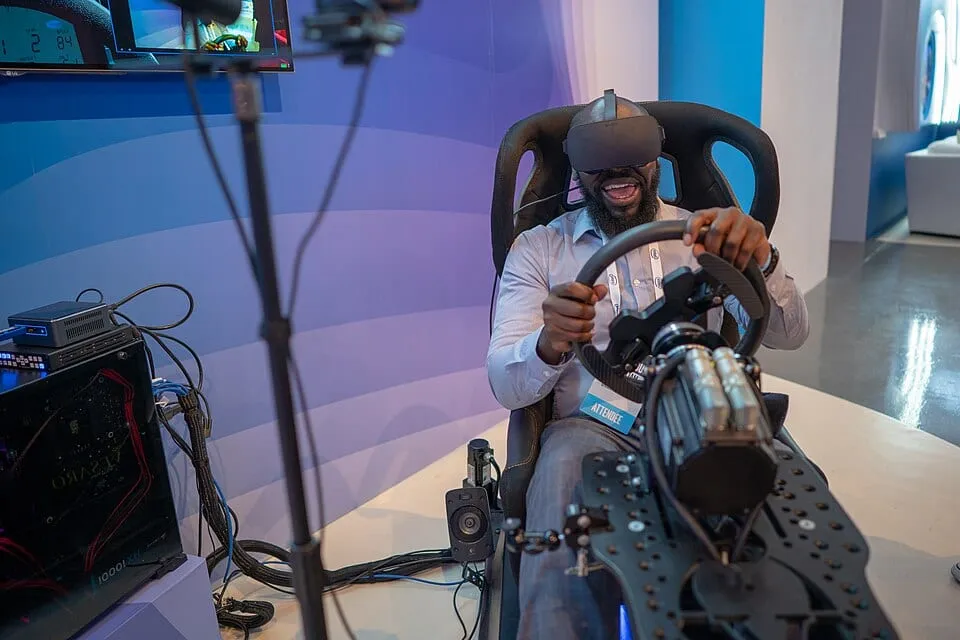
The question
Simulation solves one problem and creates two more. Realistic simulations take a long time to compute, and they also need to model how real drivers behave. We asked two questions:
- How can the virtual validation of driver-assistance systems be sped up?
- How does modelling human behaviour help their development?
What we did
- Defined the review protocol: research questions, keywords, inclusion and quality criteria.
- Searched Scopus with combinations of six keywords and screened the results.
- Extracted and compared the methods, data and findings of the relevant studies.
Findings
Most research focuses on driver behaviour: take-over situations, fog, distraction, warnings. Far fewer studies tackle the computing time itself. The promising ones use simplified models (reduced-order models, 2D instead of 3D) and smarter sampling of critical scenarios. Simplifying a model is a bit like using a sketch instead of a photo: you lose detail, but if you keep the lines that matter, you see the answer much faster. Our conclusion: research should focus more on reducing simulation time, which would make adding human behaviour affordable too.
What I took from it
A systematic review is slower than simply searching for papers, but it is fair: the rules for what counts are set before you read, so the conclusion follows the evidence, not your expectations. I used the same approach again for the literature review in my master’s thesis.
Quellen
Kontakt
Fragen, Ideen oder selbst etwas Ähnliches ausprobiert? Ich freue mich, davon zu hören. E-Mail schreiben