Master's thesis · Bosch
Using machine learning to estimate task durations
Built four prediction models on real Bosch schedule data. The lesson: fix the data before the AI.
Auf einen Blick
- Type
- Master's thesis, M.Eng. Technology & Innovation Management
- Period
- Oct 2023 – May 2024
- Data
- 4,000+ tasks from two Bosch projects
- Tools
- MS Project, Python (pandas, scikit-learn), MySQL, Signavio, Visio
Hintergrund
Written in the Project Management Office of Bosch Semiconductor Operations, Reutlingen, as my master's thesis at Hochschule Harz.
Bosch in Reutlingen
Reutlingen, south of Stuttgart, is the oldest of Bosch’s chip sites. The company has made semiconductors there since 1970. Today Reutlingen produces automotive ICs, MEMS sensors (the tiny motion and pressure sensors in airbags, stability control and smartphones) and power semiconductors, including silicon carbide chips, all on 200 mm wafers. It is the only Bosch site that combines frontend and backend manufacturing with its own test centre.

My part
From October 2023 to May 2024 I was based in the PMO in Reutlingen, with access to real schedules and to the people who build them.
The thesis is under a confidentiality notice (Sperrvermerk) agreed with Bosch, so its data, figures and internal findings are not shared here. This page describes the questions, the method and the results in general terms.
The challenge
Ask a project manager how long a task will take and you will usually get an expert’s estimate. It is a bit like guessing the length of a car journey from memory, while a navigation app works it out from thousands of earlier trips. In large projects, most task durations are still estimated the first way.
At the same time, AI was moving from headlines into everyday business. In IBM’s Global AI Adoption Index 2022, 35% of the companies surveyed said they already used AI, four points more than a year before. The PMO wanted to know what that could mean for planning, and the thesis set out two questions:
- Which kinds of AI could help a project team during the planning phase?
- Could a basic model predict task durations from a company’s own project data?
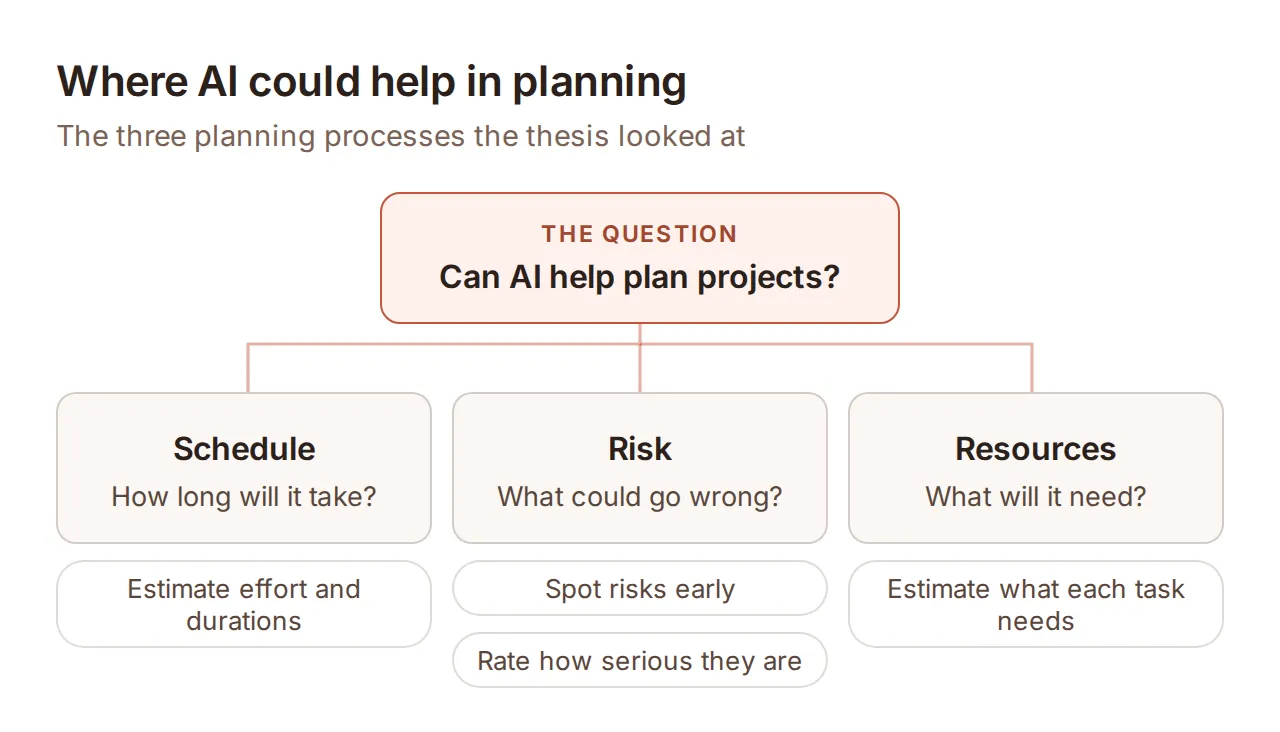
The first question needed a wide view: research, standards and how people really work. The second needed hands-on work with real data. So the thesis had two halves, an analysis and a training part.
Part 1: what research already knows
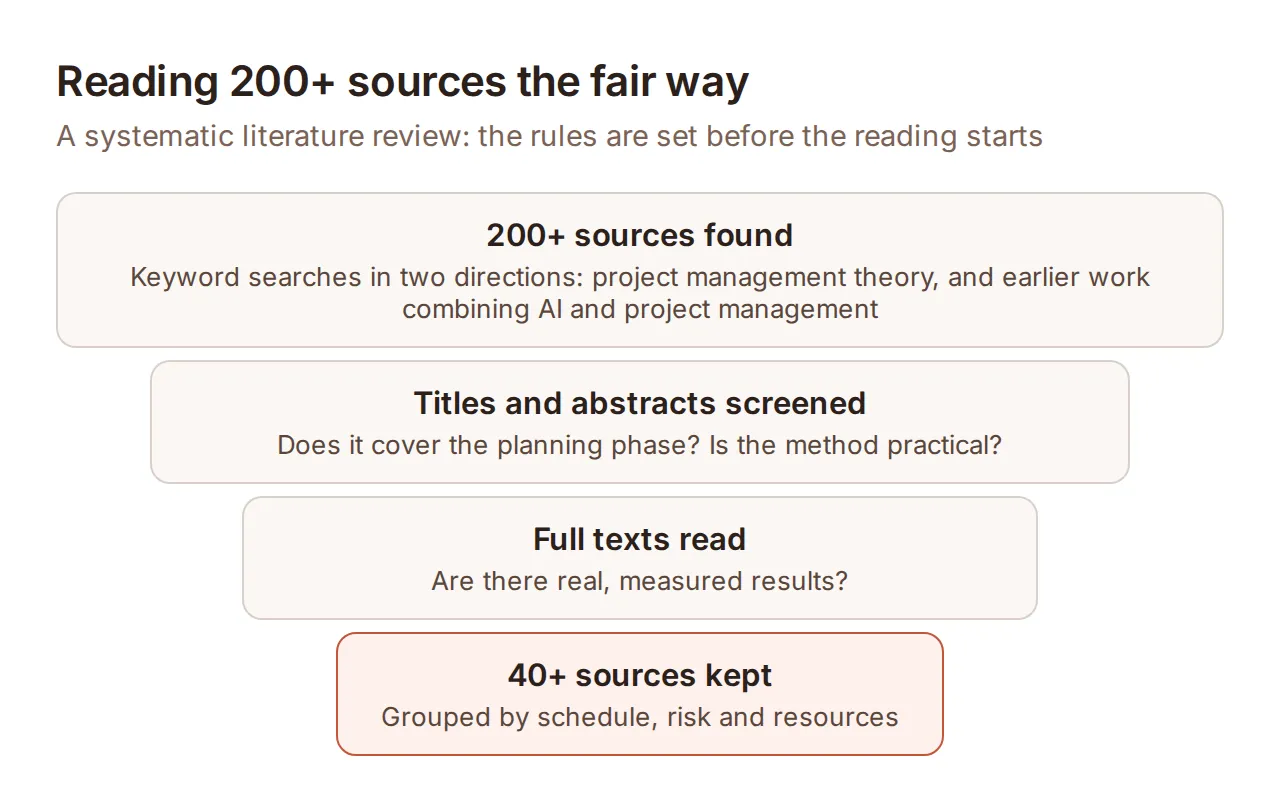
I started with a systematic literature review. Unlike a normal search, the rules for what counts are fixed before you read, so the result follows the evidence rather than your expectations. I searched in two directions, project management theory and earlier studies that combined AI with project management, and kept only work that improved the planning phase, used a practical method and showed measured results.
The theory side gave me the building blocks: how a project’s life cycle and phases are defined, and how AI splits into subfields, from machine learning to language processing, along with the algorithms, the ways to judge them and the kinds of data they need. The second direction showed what had already been tried. Most of the useful studies dealt with scheduling and risk, and only a few with resources, which already hinted at where the most experience lies.
Part 2: how planning really works
Research only tells half the story. To see where AI could actually fit, I needed to know how planning happens in practice, so I analysed the planning processes step by step and compared three versions of each: the international PMI standard, the company’s own standard, and a live project.
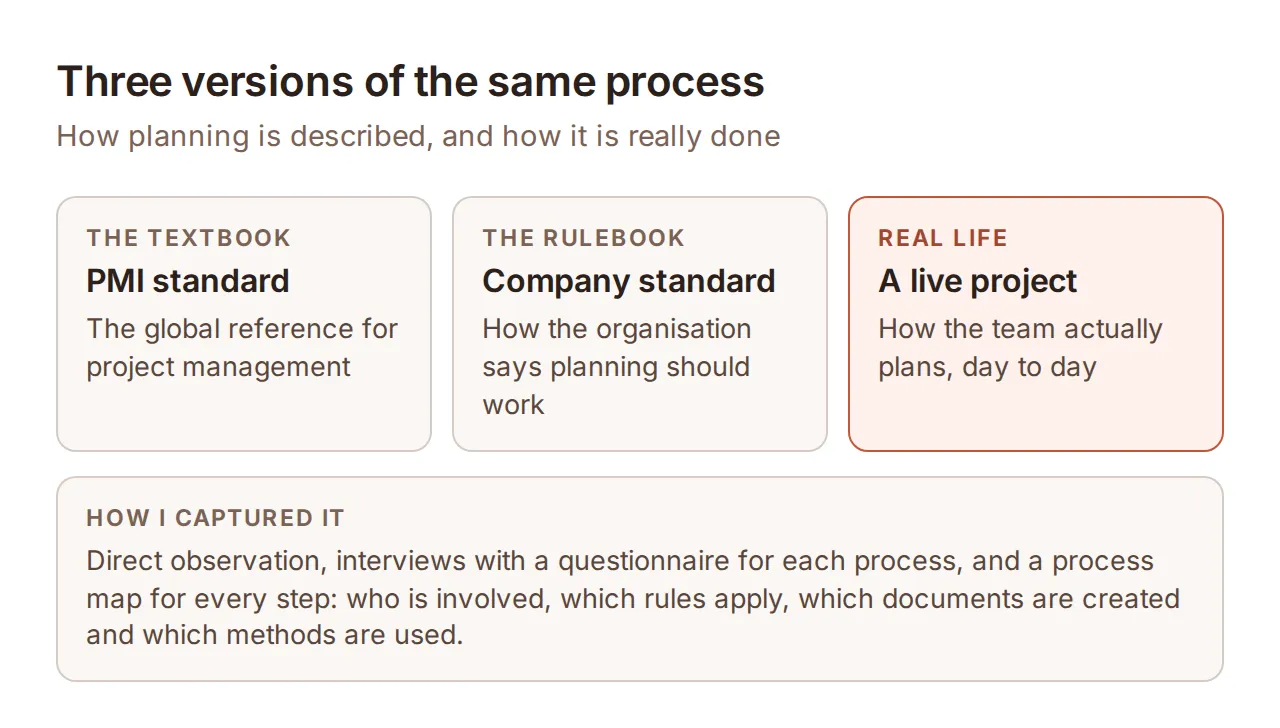
For every process I drew a map of its steps. Each step recorded four things: the people involved (for example the project manager), the rules that apply (for example a rating scale from low to high), the documents created or updated (for example a risk report) and the methods used (for example a root cause analysis). The interviews followed a questionnaire tailored to each process, plus questions about the planning phase as a whole, so the answers could be compared.
The gaps between the three were as interesting as the processes themselves. A step that looks simple in a handbook can involve several people, documents and decisions in a real project, and that is exactly where a good tool can save time.
Part 3: matching AI to the job
With both pictures in place, I compared each planning task with the AI methods from the literature. Three questions decided the match:
- The data: what kind of data does the task produce, how much of it is there, and how clean does it need to be?
- The task: is it a prediction of a number or a choice between categories, and how important is it that people can understand the answer?
- The model: can it grow with more data, handle mixed information, and stay stable when the data is messy?
Take duration estimates as an example. The data is mostly numbers, it has to be accurate, and there is a fair amount of it. The task is to predict a number, and people must be able to follow the reasoning, because the estimate goes straight into a live project plan. That profile points to some models and rules out others.
The answer to the first research question was clear: machine learning was the most useful part of AI for all three planning processes. Which model fits best, however, depends far more on the data than most studies suggest.
Part 4: from project plans to a dataset
For the second question, I needed data. I took the schedules of two large international projects of the PMO, with more than 4,000 tasks in total, and turned them into something a model could learn from.
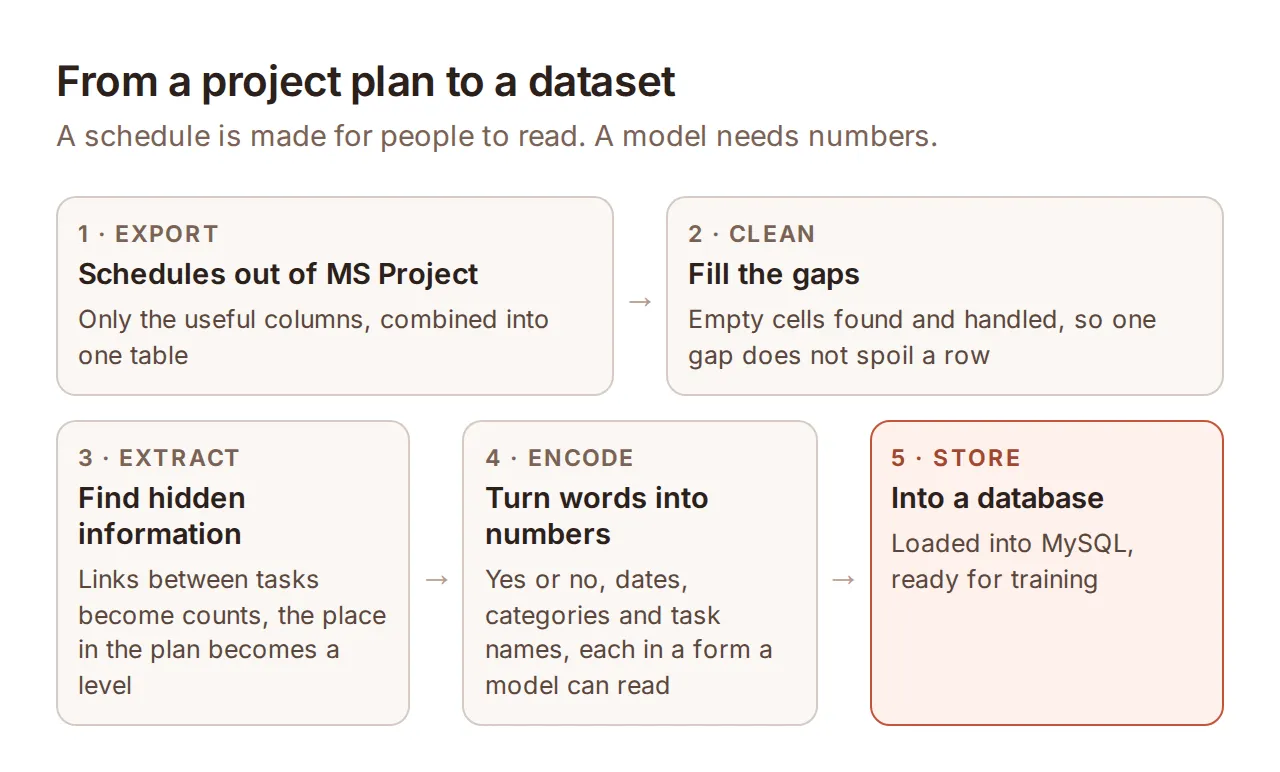
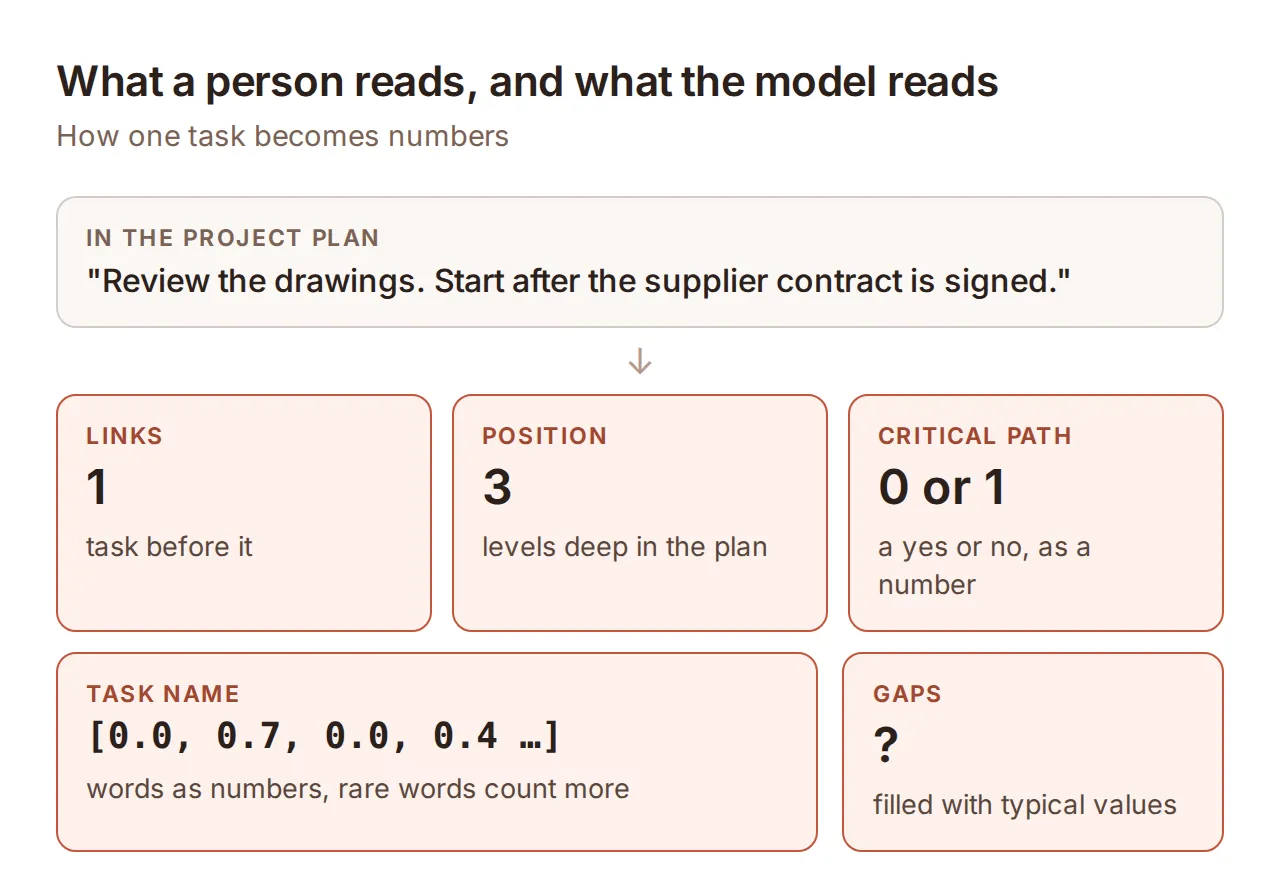
This was the longest part of the practical work, and the most instructive. Project plans are written for people. A model cannot read “finish this after the supplier contract is signed”, so every link, date and label had to become a number without losing its meaning.
A few examples of what that meant:
- Gaps: some tasks had no duration or buffer recorded. Instead of throwing them away, I filled them with typical values from the rest of the plan.
- Links between tasks: “starts after task 112 and 118” became a simple count of predecessors and successors, plus the type of link.
- Position in the plan: a project plan is organised like a book, with chapters, sections and sub-sections. Each task’s depth in that structure became a number.
- Yes or no fields: whether a task is on the critical path, or is only a summary of other tasks, became 1 or 0.
- Task names: words were turned into numbers with a method that gives more weight to rare, telling words and less to words that appear everywhere, such as “review”.
Part 5: four models, one comparison
I then built and trained four different machine learning models in Python, each a different way of learning from the same data.
Each model followed the same routine. The data was split into two parts: one to learn from, and one kept aside to test on, like studying with past exam papers and then sitting a new exam. I tried different settings for each model, such as the number of trees in a forest or the size of a neural network, and kept the best version.
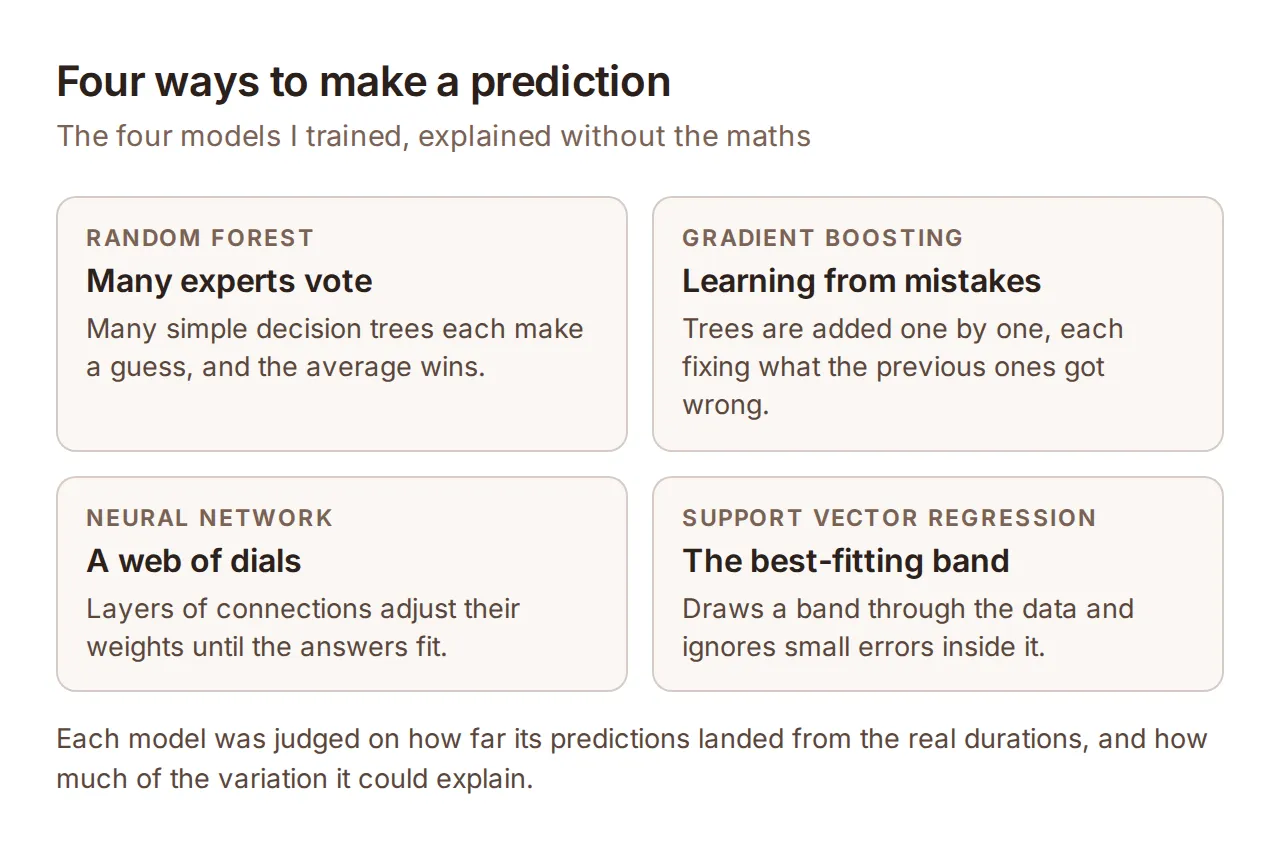
To compare them fairly, every model was judged on four measures: the average size of its errors, how strongly it was punished for big misses, how much of the variation in durations it explained, and how far off it was relative to each task’s real length. I also plotted the predicted durations against the real ones to see where each model went wrong, not just how often.
Result
The best model explained over 85% of the variation in task durations. Put simply: most of the difference between a short task and a long one could be predicted from the data alone.
The models built from many decision trees did best. The neural network, often praised in research papers, struggled with this amount of data, which says a lot about how much the data decides. I defended the thesis at Hochschule Harz in May 2024 and then presented the results to Bosch management.
What I learned
With real company data, the quality and amount of data matter more than the choice of algorithm. The models that research praises most were not the ones that worked best here. That is not because they are bad models: real project data is rarely as complete and consistent as research data, and some models cope with that much better than others. Before jumping on the AI bandwagon, fix the data foundation. Good data makes AI useful. Bad data makes it confidently wrong.
The thesis also ended with a list of next steps, for the research and for the company:
- Put a price on the time saved: estimate how many planning hours a tool would save and multiply them by salary costs, so the benefit can be compared with the cost of building it.
- Improve the data set: more projects, recorded the same way.
- Add resources: who works on a task is likely to affect how long it takes.
- Connect the processes: schedule, risk and resource data still live apart, but they influence each other.
- Add real-time factors: schedules that react to what is happening now, not only to the original plan.
- Start from what exists: check which AI tools are already available inside the company before building new ones.
Quellen
- Hochschule Harz: Technology and Innovation Management (M.Eng.) ↗hs-harz.de
- IBM: Global AI Adoption Index 2022 (May 2022) ↗newsroom.ibm.com
- Bosch Semiconductors: the wafer fab in Reutlingen ↗bosch-semiconductors.com
Kontakt
Fragen, Ideen oder selbst etwas Ähnliches ausprobiert? Ich freue mich, davon zu hören. E-Mail schreiben