University project · Technology assessment
Sustainable buildings in Germany, India and Nigeria
A PESTEL analysis of what helps and what blocks sustainable buildings in three countries. My part was India, where tradition, climate and loose rules pull in different directions.
Auf einen Blick
- Type
- Group assignment, team of five
- My part
- The analysis of India
- Period
- Nov 2021
- Countries
- Germany, India, Nigeria
- Method
- PESTEL analysis, impact and uncertainty matrix
Hintergrund
A group assignment in the course Technology Assessment and Sustainability, part of the master's programme Technology and Innovation Management at Hochschule Harz, presented in November 2021.
The question
What will sustainable buildings look like in the future? Our group took that question to three very different countries: Germany, India and Nigeria. The brief was to find out what pushes each country towards greener buildings, what holds it back, and which factors matter most.
Each of us took a part. Mine was India.

The method: PESTEL
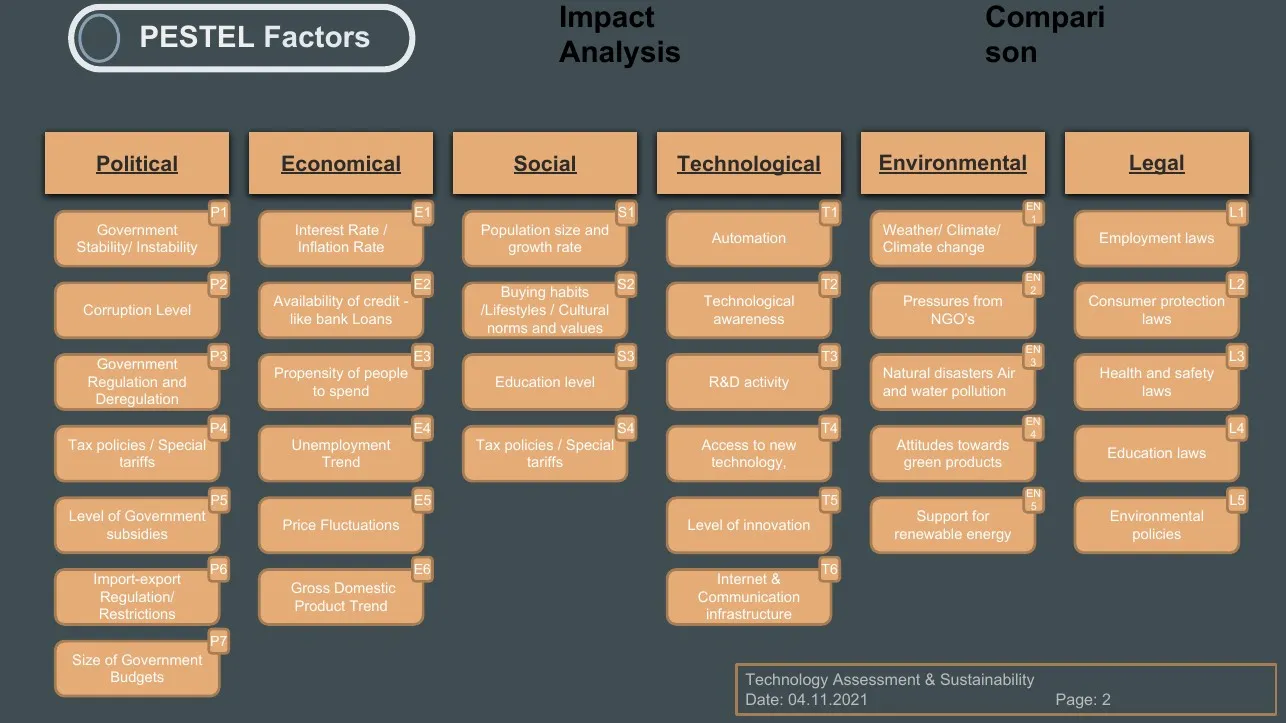
PESTEL is a checklist for looking at everything around a topic, not just the technology. It stands for six kinds of factors:
- Political, such as government stability or subsidies.
- Economic, such as interest rates or how easy it is to get a loan.
- Social, such as lifestyle, values and education.
- Technological, such as innovation and access to new technology.
- Environmental, such as climate and attitudes towards green products.
- Legal, such as building, safety and environmental laws.
We agreed on a shared list of more than 30 factors, each with a code like P1 or T4, so that all three countries were judged the same way.
Sorting the factors
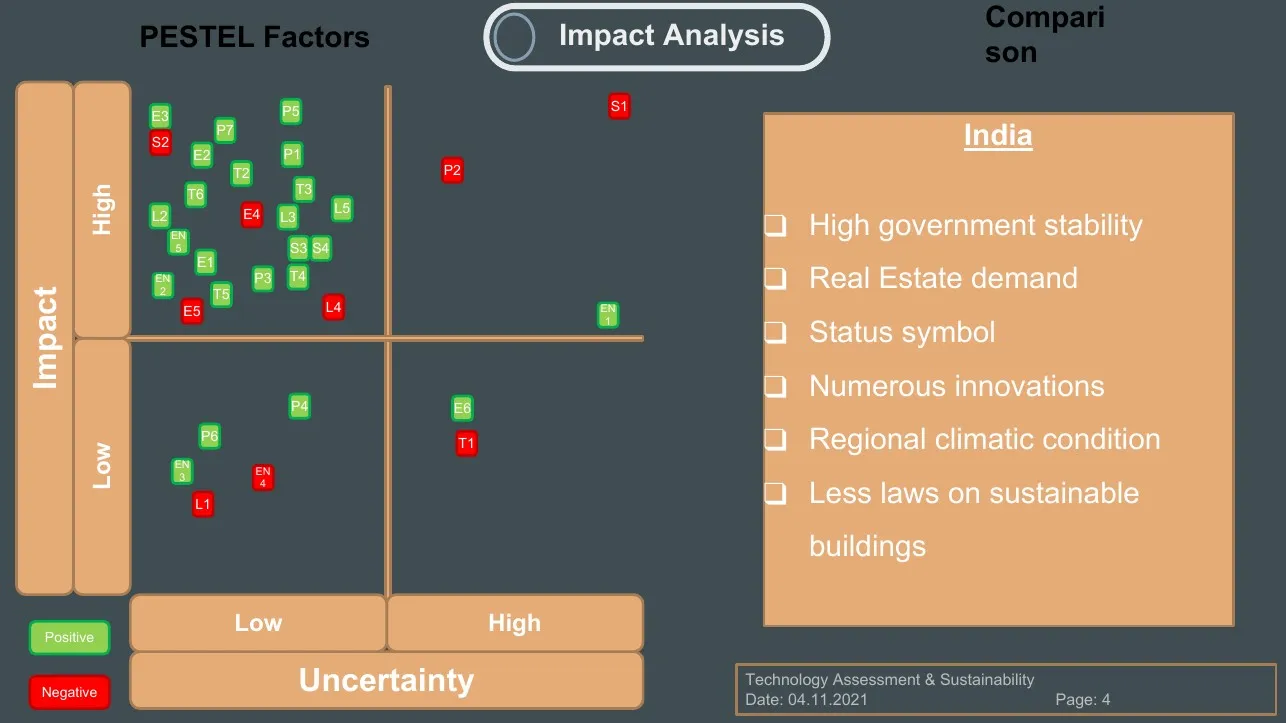
A long list does not tell you what to focus on. So we placed every factor on a simple map with two questions:
- Impact: how strongly does it affect sustainable building?
- Uncertainty: how hard is it to predict how it will develop?
Green marked factors that help, red those that hold things back. The factors in the top left, strong impact and fairly predictable, are the ones to plan around first.
What I found for India
India turned out to be a country of contrasts.
What helps:
- The government is pushing. India introduced its own green building rating system, GRIHA, and the Indian Green Building Council was set up to guide sustainable construction.
- Huge demand. Cities are growing fast, and so is the need for new housing. Every new building is a chance to build it better.
- Old wisdom. Traditional Indian architecture, including Vastu Shastra, already plans houses around wind, light and rain. Many rural buildings are green by design, long before anyone used the word.
- Room for innovation. New sustainable materials and building methods keep appearing, and foreign investment in construction is allowed.
What holds it back:
- Houses as status symbols. For many families, a house shows success, so lavish often wins over efficient.
- One country, many climates. India ranges from hot and humid to cold and dry. A green building standard that works in one region may fail in another.
- Loose rules. There was no law requiring sustainable building, and each city had its own rules, with little penalty for breaking them.
- Cost and skills. Green materials and equipment are expensive, and the skilled workers needed to install them are scarce.
Three countries side by side
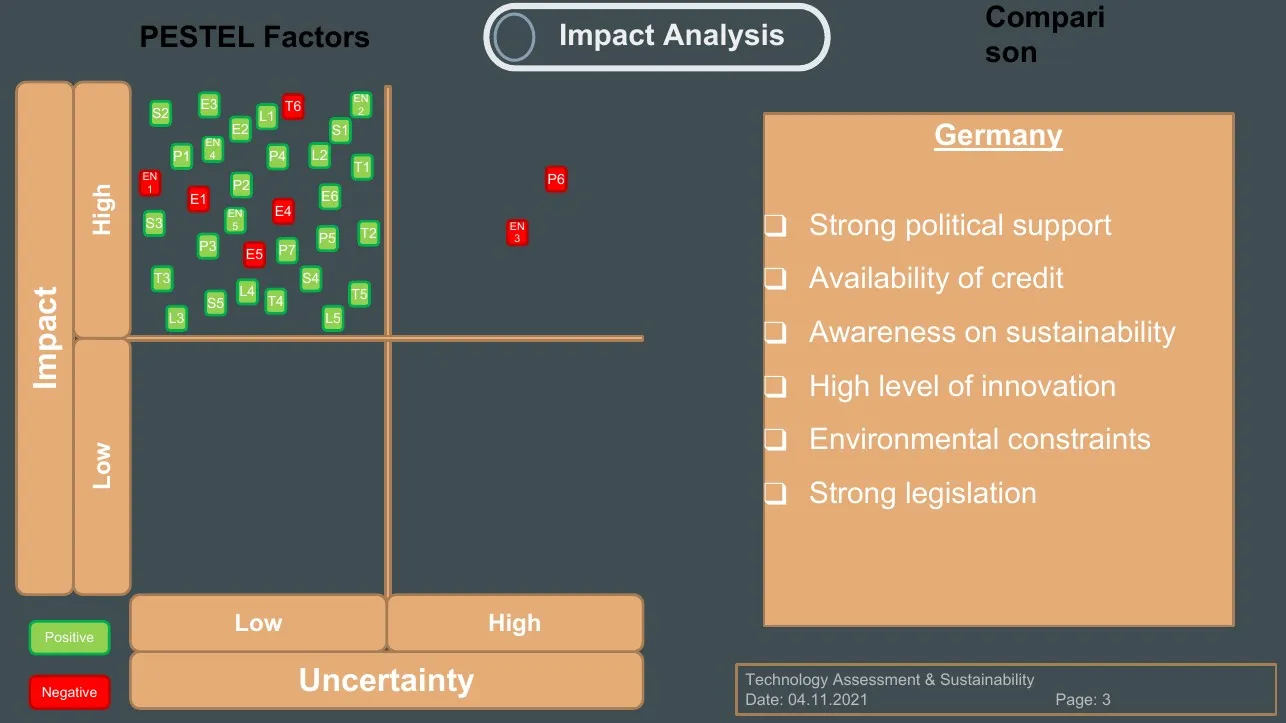
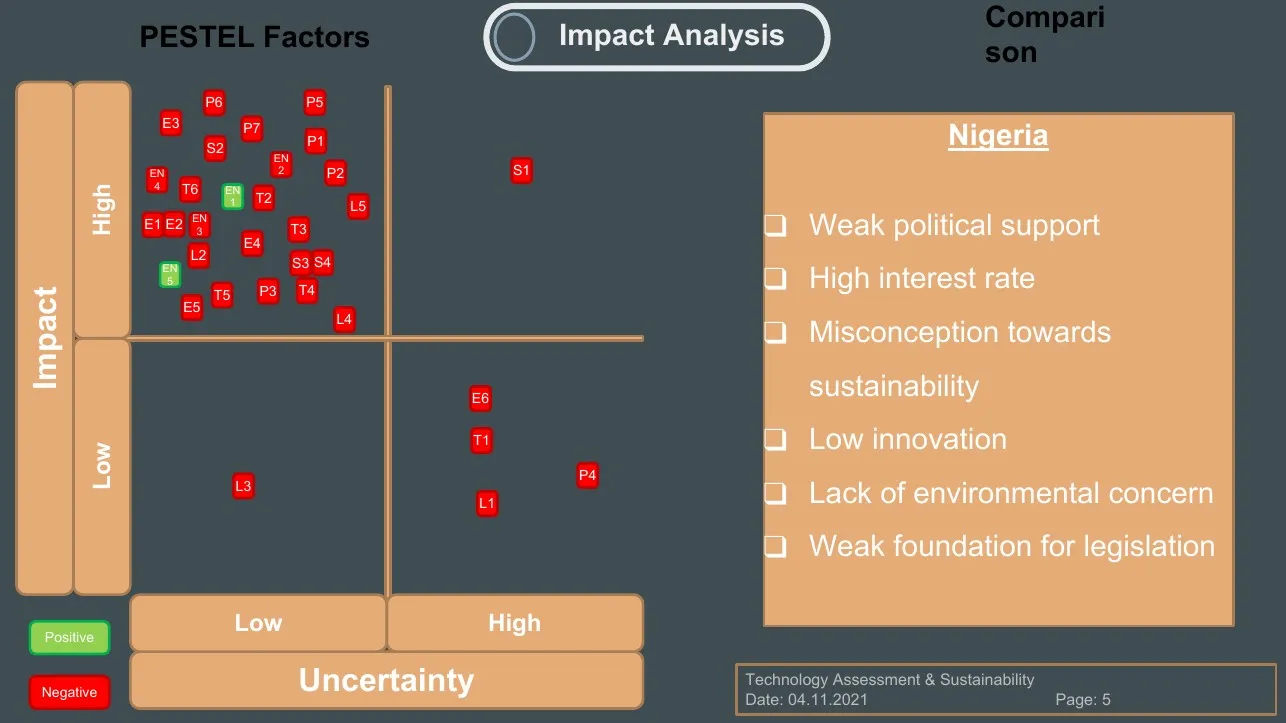
The comparison was the most interesting part. The same list of factors produced three very different pictures:
- Germany had strong political support, easy access to credit, high awareness and strict legislation. Most factors were helpful and predictable.
- India had a stable government and strong demand, but weak and uneven laws, and a culture where a house is also a statement.
- Nigeria faced weak political support, high interest rates, low innovation and a common belief that green buildings are a luxury rather than a long-term need.
What I took from it
Technology was never the main barrier. The materials and methods for greener buildings exist in all three countries. What decides whether they are used are money, rules and what people value. That changed how I look at any new technology: before asking whether it works, ask whether the people, the laws and the budgets around it are ready.
Quellen
- Wikipedia: PEST analysis ↗en.wikipedia.org
Kontakt
Fragen, Ideen oder selbst etwas Ähnliches ausprobiert? Ich freue mich, davon zu hören. E-Mail schreiben