Fired on Friday, back by Wednesday: five days of OpenAI chaos
· 4 Min. Lesezeit
Two weeks ago, OpenAI held its first developer conference. Sam Altman stood on stage, announced new products and talked about the future. ChatGPT had about 100 million weekly users. It was the most exciting company in tech.
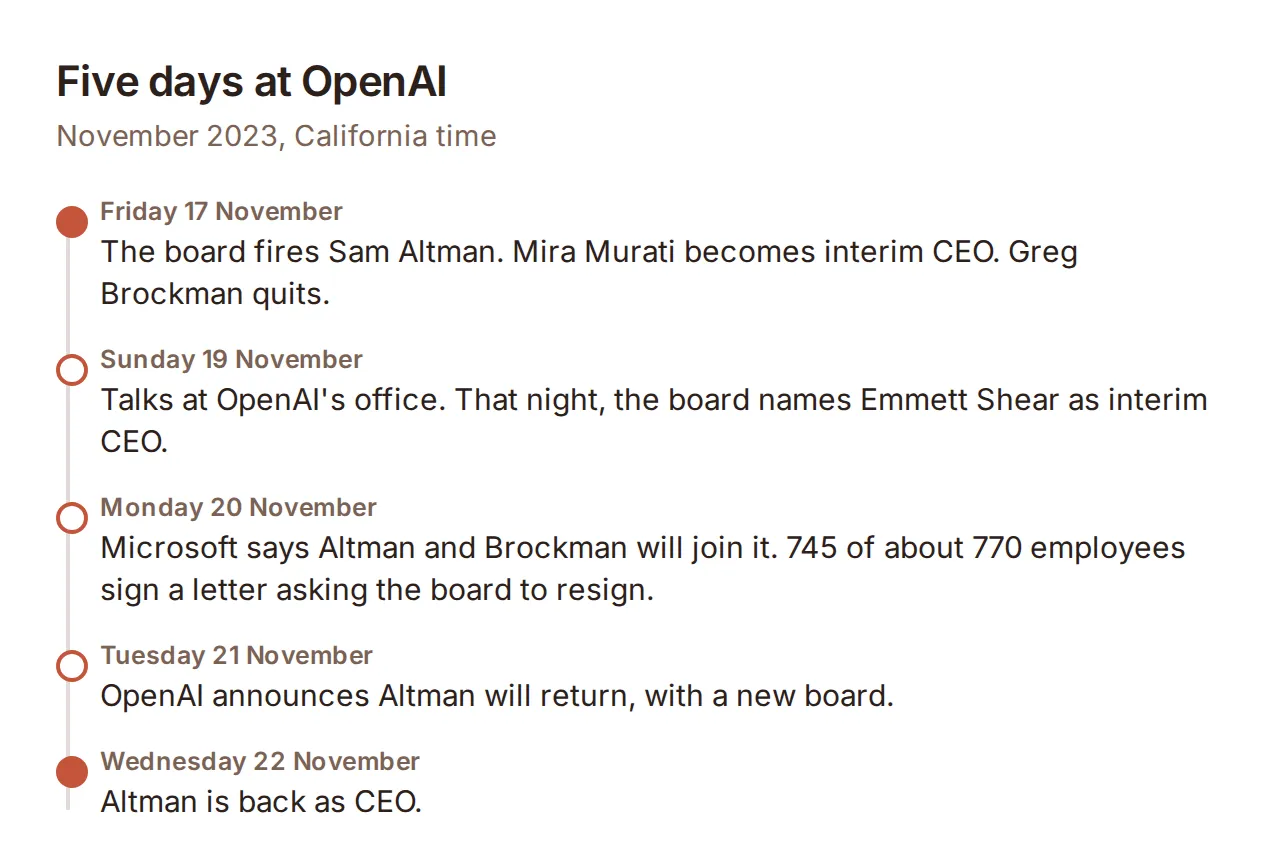
Then, on Friday, 17 November, the board fired him.
What followed was the strangest five days I can remember in tech.
Friday: the firing
Around midday in California, OpenAI published a short blog post. Altman was out, effective immediately. The board said he “was not consistently candid in his communications with the board”, and that it “no longer has confidence in his ability to continue leading OpenAI.”
Altman reportedly got the news on a video call only minutes before it went public. Mira Murati, the chief technology officer, became interim CEO. Greg Brockman, co-founder and chairman, was removed as chairman, and quit a few hours later.
Nobody outside the board seemed to know what “not consistently candid” actually meant. Not employees, not the public, and reportedly not even Microsoft, which had invested billions in OpenAI.
Wait, how can a board fire the founder?
This is the part most people did not know. OpenAI is not a normal company.
It started in 2015 as a non-profit, with a mission to make sure that very powerful AI benefits all of humanity. Later, it created a company underneath the non-profit to raise money and sell products. But the non-profit’s board stayed in control, and that board’s duty is to the mission, not to investors or profits.
At the time, the board had six members. After Altman and Brockman were pushed out of it, four were left: chief scientist Ilya Sutskever and three people from outside the company. Four people decided the fate of one of the most valuable startups in the world, and the investors had no vote.
The weekend: negotiations
By Saturday, investors and employees were pushing to bring Altman back. On Sunday, Altman went to OpenAI’s office for talks and posted a photo of himself wearing a visitor’s badge, with the caption “first and last time i ever wear one of these”.
It was not the last time he wore one that weekend. On Sunday night, the board picked a different interim CEO: Emmett Shear, the co-founder of the video streaming site Twitch. Murati had been interim CEO for about two days.
Monday: everyone threatens to leave
Early on Monday, Microsoft’s CEO Satya Nadella announced that Altman and Brockman would join Microsoft to lead a new AI research team.
Then the employees moved. A letter to the board demanded that it resign and bring Altman back, or they would leave and could join him at Microsoft. By the end, 745 of OpenAI’s roughly 770 employees had signed it.
The most surprising name on the list: Ilya Sutskever, one of the board members who had voted to fire Altman. He posted that he deeply regretted his participation in the board’s actions.
Over Monday and Tuesday, timelines filled with OpenAI employees all posting the same sentence: “OpenAI is nothing without its people.”
Tuesday night: the comeback
Late on Tuesday, OpenAI announced an agreement. Altman would return as CEO, with a new board: Bret Taylor, former co-CEO of Salesforce, as chair, the economist Larry Summers, and Adam D’Angelo, the only member of the old board to stay. An independent investigation into what happened would follow.
By Wednesday, Altman was back. Five days, three CEOs, and one company that nearly emptied itself.
What I think
I still do not know why the board did it, and as of today, nobody has explained it properly. Maybe there was a good reason. But even a good reason needs a good process, and this one had almost none: no warning to the main investor, no clear explanation to employees, no plan for the next day. When you surprise every stakeholder at once, you lose all of them at once.
It is also worth asking what the employees were really voting for. Loyalty to Altman was clearly real. But at the time, OpenAI was reportedly preparing a share sale for employees that valued the company at around $86 billion. A board that fires the CEO and scares off investors puts that money at risk. I do not think that makes the letter fake. I just think “OpenAI is nothing without its people” was also, quietly, about the people’s shares.
The second lesson is about where power really sits. On paper, the board was in charge. In practice, the power was with the people who could walk out, and with the company that could hire them all. A structure only works if the people inside it accept it.
And the third lesson is a slightly uncomfortable one. OpenAI’s unusual structure was meant to be a safety brake: a board that could stop the company if it moved too fast, even against the wishes of investors. The first time the brake was pulled, the car just kept going, and the brake was replaced.
Maybe that was the right outcome. Maybe it was not. But it is worth remembering that a handful of people, in a few days, decided how one of the most important AI companies in the world is run. Most of us found out from the news, like everyone else.