University project · Mechanical engineering
Designing a vertical axis wind turbine
Designing and simulating a vertical axis wind turbine with wing-shaped blades in SOLIDWORKS, and testing in ANSYS how it handles wind and load.
At a glance
- Type
- Bachelor's final project, team of three
- My part
- Design and simulation
- Status
- Designed and simulated, not built
- Period
- 2018 – 2019
- Turbine
- Darrieus-type vertical axis wind turbine, NACA 0018 blades
- Tools
- SOLIDWORKS 2018, ANSYS Workbench (2D CFD and structural analysis)
About
My final-year project in the Bachelor of Technology in Mechanical Engineering at Malla Reddy College of Engineering and Technology in Hyderabad, India, completed in a team of three in the academic year 2018/19.
Why a different kind of wind turbine
When you picture a wind turbine, you probably see the tall white one with three long blades on top of a tower. That is a horizontal axis turbine. It is very efficient, but it has to turn to face the wind, needs a massive tower, and is far too big for a rooftop or a roadside.
A vertical axis wind turbine spins around an upright shaft, like a merry-go-round. It catches wind from any direction, so it never needs to turn, and the heavy parts can sit close to the ground. That makes it a good fit for cities, rooftops and places where the wind keeps changing.
There are two main types:
- Savonius, with scoop-shaped blades that are pushed around by the wind, like cups. It starts easily but is slow and not very efficient.
- Darrieus, with blades shaped like aircraft wings. The wind creates lift, the same force that keeps a plane in the air, so it spins faster and turns more of the wind into power.
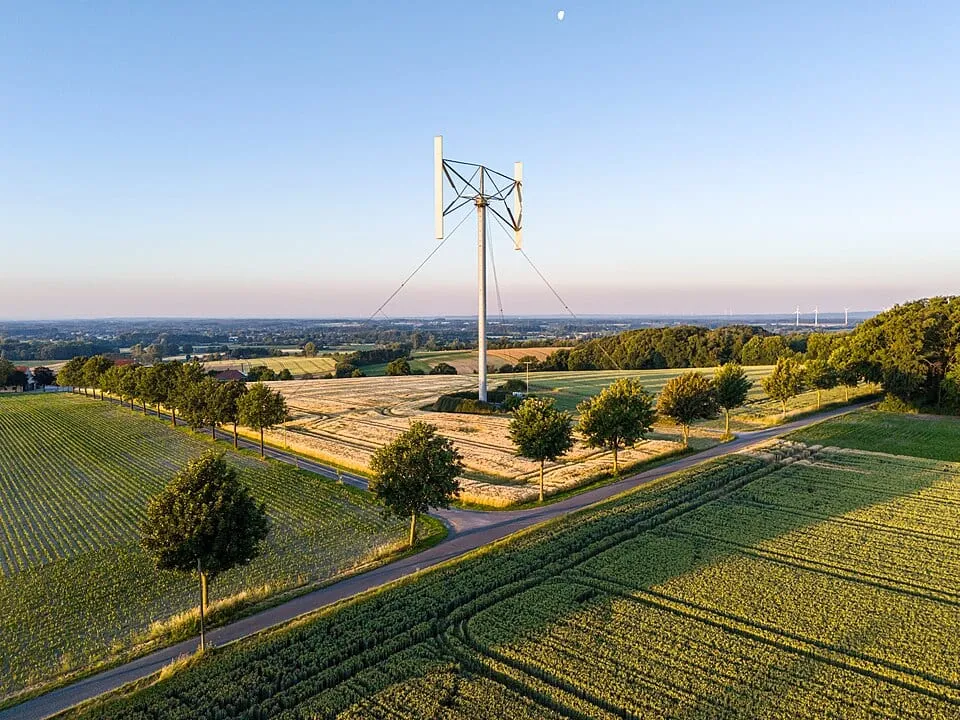
Our project was part of ongoing research at the college. The earlier version was a Savonius turbine. Our phase was to move to a Darrieus design, which meant designing every part again from scratch, with three goals: more torque and speed, a portable structure, and a very low cost.
My part: the design
I did the design and the simulation. My two teammates wrote the report and prepared the presentation.
The turbine was designed for a light wind of just 2 m/s, a light breeze, at 100 rpm. The main dimensions:
- Rotor with a radius of 1 m.
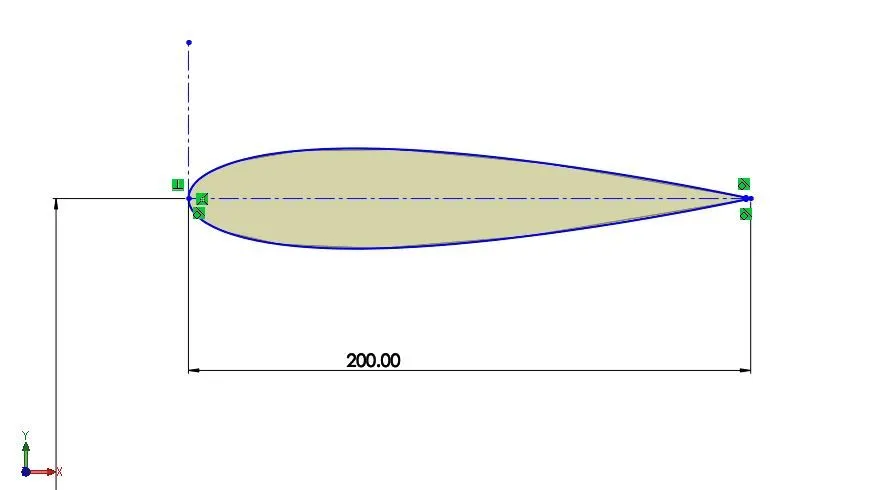
- Blades 2 m long, with a 200 mm wide wing profile called NACA 0018, a standard wing shape from NACA, the agency that later became NASA. Fibreglass, to keep them light and stiff.
- Arms and centre shaft made of mild steel tubes, joined to discs on the shaft with 24 M16 bolts.
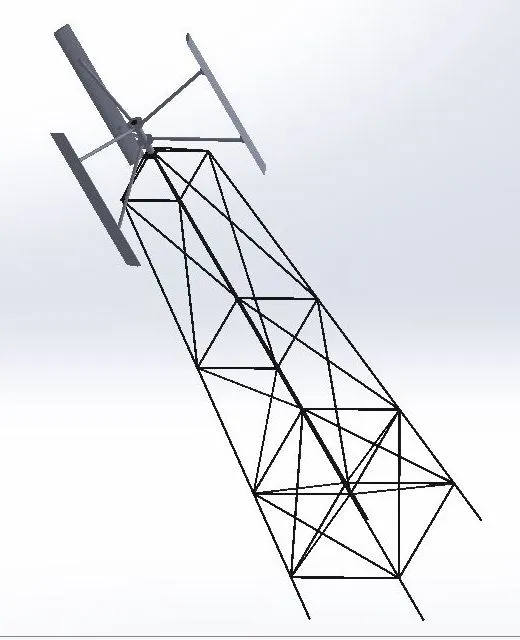
- A lattice tower, like a small electricity pylon, to hold the rotor.
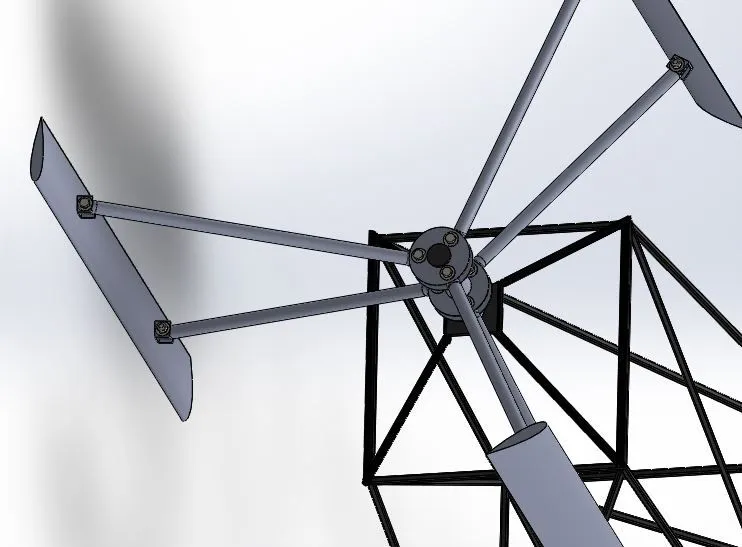
I built everything in SOLIDWORKS 2018. Each blade started as the NACA 0018 outline, imported point by point and turned into a smooth curve, then extruded into a solid. The arms were swept along a guide line, the shaft and its discs were extruded and drilled for the bolts, and the tower was drawn as a 3D sketch and turned into a steel frame. Finally, all parts came together in one assembly, fixed in place with mates the same way they would be bolted together in reality.
Testing it in the computer
The turbine was designed and simulated, not built. I tested the design in ANSYS Workbench:
- 2D CFD analysis. CFD, computational fluid dynamics, simulates how air flows around the blades. A slice through the rotor was tested at different wind speeds to study the torque and power the turbine could produce.
- Structural analysis. The blade was loaded the way the wind would load it, with different materials, to check how it bends and where stress builds up. The goal was a blade light enough to start turning in weak wind, but strong enough to last.
The settings for both came from published studies, so the results could be compared with known work.
What I took from it
This project taught me how many decisions hide inside one simple goal like “make it spin in light wind”. Lighter blades start more easily but bend more. More blades catch more wind but add weight and cost. Every choice moved something else. Testing those trade-offs in software first, before anything is built, is a habit I have kept: find out cheaply what does not work, then spend the real effort on what does.
Sources
- Wikipedia: Vertical-axis wind turbine ↗en.wikipedia.org
Get in touch
Questions, ideas, or tried something similar yourself? I'd love to hear about it. Email me