DeepSeek: the cheap AI that scared Silicon Valley
· 5 min read
For two years, the story of AI has been simple: the best models need the most money. Billions of dollars, tens of thousands of the newest Nvidia chips, giant data centres. Only a handful of American companies could afford to play.
Then, on 20 January, a Chinese company most people had never heard of released a model called DeepSeek-R1. Within a week, it was the most downloaded free app in the US App Store, ahead of ChatGPT. And on Monday, 27 January, the stock market had what can only be described as a panic attack.
Who is DeepSeek?
DeepSeek is not a tech giant. It started inside High-Flyer, a Chinese hedge fund run by Liang Wenfeng that used AI for trading. In 2023, its AI lab became its own company. It is small, it does not chase publicity, and until this month it was mostly known to AI researchers.
That is part of why the shock was so big. This was not Google or Microsoft. It was a side project of a hedge fund.
What R1 actually does
R1 is a reasoning model. Instead of answering immediately, it thinks first, step by step, and you can watch it think. You ask a tricky maths question, and it writes things like “wait, let me check that again” before answering. It is oddly charming, like watching a student mutter through an exam.
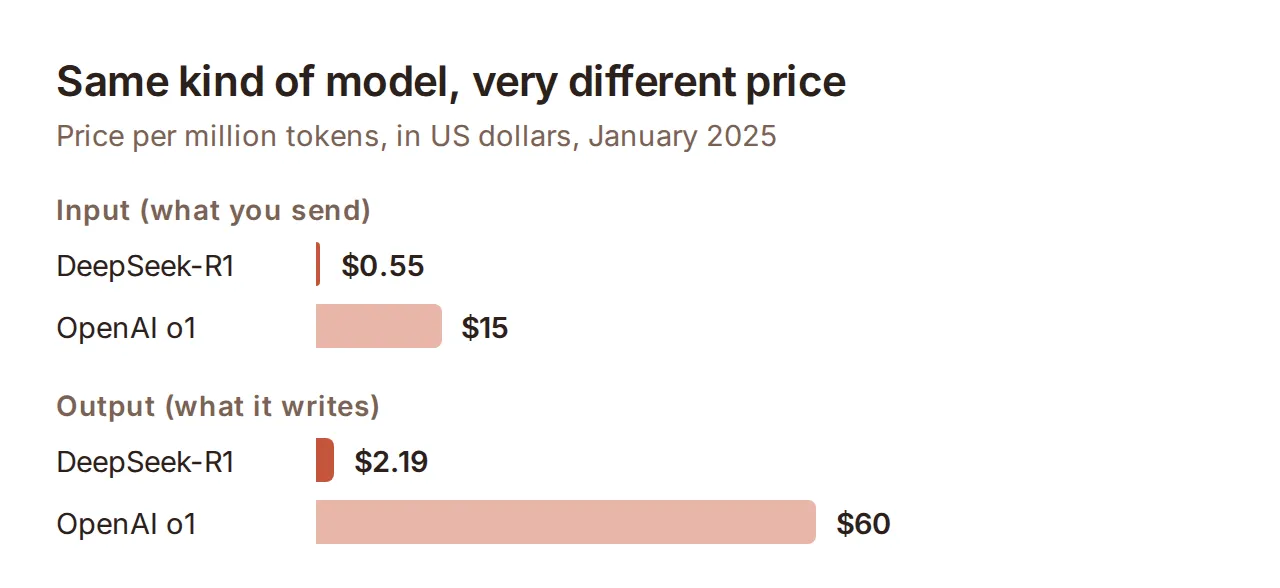
OpenAI has a model that works like this too, called o1. The surprise was that R1 is roughly as good on many tests, and much cheaper. Through DeepSeek’s own service, using R1 costs about $0.55 per million tokens of input (a token is roughly a piece of a word) and $2.19 per million tokens of output. OpenAI’s o1 costs $15 and $60. That is not a small discount. That is a different price category.
And R1 is open. DeepSeek published the model itself under a very free licence, so anyone can download it, run it on their own computers and build on it.
The $6 million question
The number that really caused the panic came from DeepSeek’s earlier model, V3, which R1 is built on. In its technical paper, DeepSeek said the final training run used about 2.8 million hours of computing time on Nvidia H800 chips. At $2 an hour, that is about $5.6 million.
For comparison, American companies talk about training costs in the hundreds of millions.
The H800 matters too. It is a weakened version of Nvidia’s top chip, made specifically so it could still be sold to China under US export rules. So DeepSeek built a top model with fewer, weaker chips, and less money.
There is an important footnote, which many headlines skipped. DeepSeek itself said the figure covers only that final training run, not the research, failed experiments and hardware that came before. It is a bit like saying a wedding cost the price of the cake. The real total is certainly much higher. But even with that footnote, DeepSeek clearly did more with less.
The day the market blinked
The logic investors followed went like this: if you can build top AI cheaply, maybe the world does not need to buy quite so many of Nvidia’s expensive chips.
On 27 January, Nvidia’s shares fell by about 17%. Around $590 billion of its value disappeared in one day, the biggest one-day loss for any company in US stock market history. Other chip and energy companies fell with it.
The investor Marc Andreessen called R1 “AI’s Sputnik moment”, after the Soviet satellite that shocked the US in 1957. President Trump called it a “wake-up call” for American industry. Sam Altman, OpenAI’s boss, called R1 “an impressive model, particularly around what they’re able to deliver for the price”.
Microsoft’s CEO Satya Nadella had a different take, and mentioned the Jevons paradox. It is a 160-year-old idea from economics: when something gets more efficient and cheaper, people often end up using much more of it, not less. Cheaper AI might mean far more AI, and in the end more chips, not fewer.
The catches
It is not all simple.
First, DeepSeek’s own app follows Chinese rules on what it can talk about. Ask it about Tiananmen Square in 1989, and it politely changes the subject. Your conversations are stored on servers in China, which is why Italy’s data protection authority has already blocked the app there.
Second, OpenAI says it has seen signs that DeepSeek used OpenAI’s models to train its own, a technique called distillation, which its terms forbid. That may well be true. But many people also pointed out the irony: OpenAI’s own models were trained on huge amounts of text from the internet, mostly without asking the people who wrote it.
Third, because the model itself is open, you do not have to use DeepSeek’s app at all. Companies can run R1 on their own servers, anywhere. That is good for privacy, and it also means nobody can really take it back.
What I think
The panic will probably calm down. Nvidia is not going out of business, and the people who need the most powerful AI will still buy a lot of chips.
But something real changed this month. The idea that only a few rich American companies can build top AI took a big hit. A small team with limited chips found clever ways to do more with less, and then gave the result away.
There is a nice lesson in that, far beyond AI. Constraints are not always a disadvantage. When you cannot simply buy more of everything, you are forced to think harder about what you really need. Anyone who has run a project on a tight budget knows that the scrappiest teams sometimes find the smartest solutions.
There is also an uncomfortable question for Washington. The US limited which chips could be sold to China, to slow Chinese AI down. In DeepSeek’s case, the limits seem to have pushed engineers to become more efficient instead. I am not saying the rules were wrong. But sanctions that make your rival leaner and smarter are not quite the outcome anyone planned.
The AI race is no longer just about who has the most money. It is also about who wastes the least.