Thank you, Tim
· 9 min read
On Monday, 31 August, Tim Cook had his last day as Apple’s CEO. On Tuesday, John Ternus, the head of hardware engineering, took over. No drama, no interim boss, no leaked emails. Just a date, announced back in April and kept exactly.
Which is, honestly, the most Tim Cook way to leave.
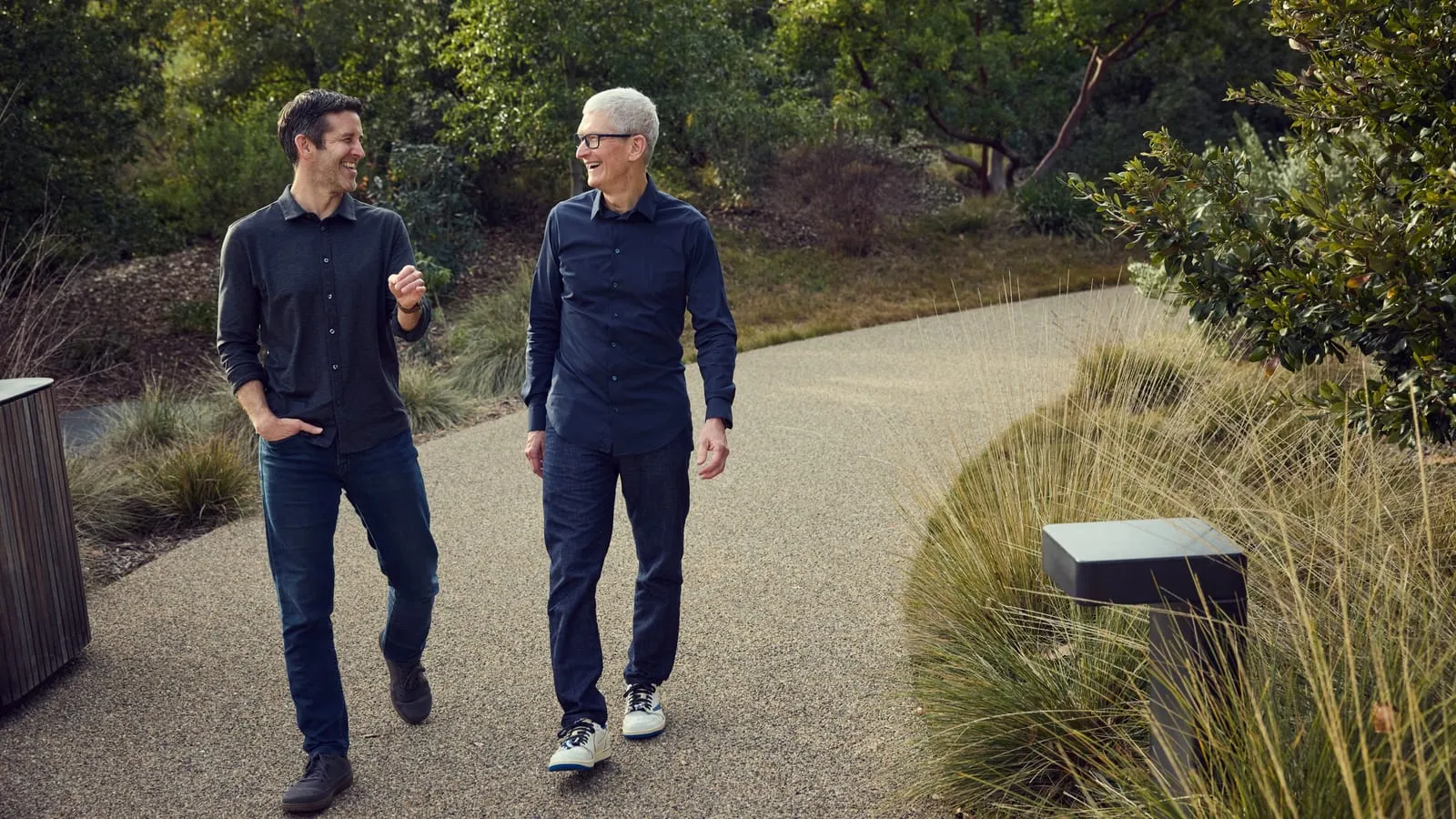
I have to admit something before I start: I am a big Tim Cook fan. Not the loud kind. The kind who reads his interviews to the end and has watched more Apple keynotes than is probably healthy. So this is not a neutral news story. It is a thank-you, with the whole story, from the beginning.
A boy from Robertsdale, Alabama
Tim Cook was born on 1 November 1960 in Mobile, Alabama, and grew up in Robertsdale, a small town nearby. His father worked at a shipyard. His mother worked at a pharmacy.
He studied industrial engineering at Auburn University, finishing in 1982. Industrial engineering is the discipline of making systems work better: factories, supply chains, processes. Less glamorous than designing products, but it is the reason products actually arrive. Later, he did an MBA at Duke University.
His first big job was at IBM, where he spent twelve years in the personal computer business, ending up responsible for fulfilment in North America. Then he moved to a computer reseller, Intelligent Electronics, and in 1997 to Compaq, at the time the biggest PC maker in the world.
He was successful, secure, and on a very sensible career path. Then Steve Jobs called.
The interview that changed his life
In 1998, Apple was not the Apple we know. Steve Jobs had come back only a year earlier to a company that was close to going under. People around Cook told him that leaving Compaq for Apple was a bad idea.
Cook met Jobs anyway. In his commencement speech at Auburn in 2010, he described the decision as listening to his intuition rather than his careful analysis. He said joining Apple was “a once-in-a-lifetime opportunity to work for the creative genius”. He joined in early 1998 as head of worldwide operations, six months after starting at Compaq.
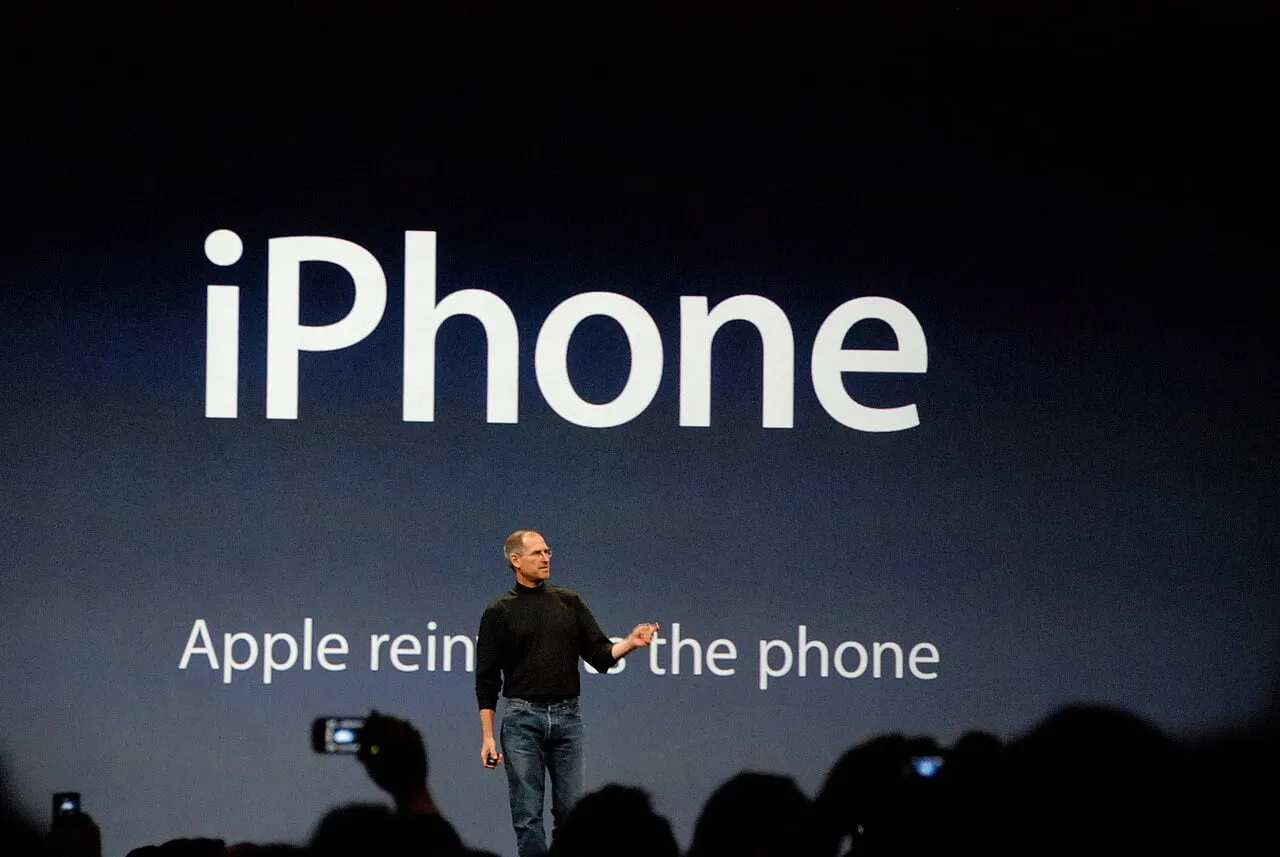
It is one of my favourite career stories, because it goes against everything that sounds sensible on paper. The logical choice was to stay at the bigger, safer company. The right choice was to go to the struggling one with the genius.
Fixing Apple from the inside
Jobs fixed Apple’s products. Cook fixed everything behind them.
When he arrived, Apple ran its own factories and warehouses and had huge amounts of unsold stock sitting around. Cook closed factories and warehouses, moved production to contract manufacturers, and cut inventory from months to days. He famously described inventory as “fundamentally evil”, and compared Apple to a dairy: you want to sell your products while they are fresh, not let them sit until they go off.
This sounds boring. It was revolutionary. A company that holds days of stock instead of months frees up huge amounts of money and can switch to new products much faster. Every company that later tried to copy Apple’s operations was copying Tim Cook.
One example of how far ahead he thought: in 2005, his team locked in long-term supplies of flash memory. Flash memory is what made the iPod nano, and later the iPhone, possible at the scale Apple needed. When other companies wanted the same chips, Apple had already bought them.
In 2005 he became chief operating officer. He was, quietly, the second most important person at Apple.
Steve and Tim
Jobs and Cook were very different people. Jobs was intense, emotional, a perfectionist about every pixel. Cook was calm, precise and famously polite. The pairing worked because each was strong where the other was not.
When Jobs became ill, Cook was the one who kept the company running. In 2009, while Jobs was on medical leave for a liver transplant, Cook led Apple. In early 2011, during Jobs’s third medical leave, he ran most of the day-to-day business again.
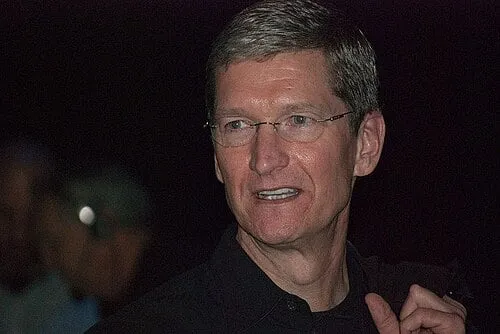
The most moving story about the two of them is from that time. Cook found out that he had the same rare blood type as Jobs. He went through medical tests and learned that he could donate part of his liver. When he offered, Jobs refused before Cook had even finished speaking. Cook later said Jobs only yelled at him four or five times in the thirteen years they worked together, and this was one of them.
Cook took it as a sign of how unselfish Jobs could be. I take it as a sign of who Cook is: the kind of colleague who would offer part of himself, and the kind of person who would only tell the story years later, quietly, in a book.
“That day has come”
On 24 August 2011, Steve Jobs resigned as CEO. His letter to the board and the Apple community began: “I have always said if there ever came a day when I could no longer meet my duties and expectations as Apple’s CEO, I would be the first to let you know. Unfortunately, that day has come.”
And then: “I strongly recommend that we execute our succession plan and name Tim Cook as CEO of Apple.”
On 4 October, Cook led his first big product event as CEO, introducing the iPhone 4S. The next day, Steve Jobs died.
I cannot imagine a heavier start to a new job.
“Never ask what I would do”
Jobs gave Cook one piece of advice that Cook has repeated many times since. Jobs had watched what happened at Disney after Walt Disney died: for years, people kept asking “what would Walt have done?”, and the company froze. He did not want that for Apple. So he told Cook never to ask what Steve would do. Just do what is right.
I think this is the most important thing to understand about Cook’s Apple. He did not try to be Steve Jobs. He did not copy the black turtleneck or the stage drama. He ran Apple his own way, and he was allowed to, because Jobs had told him to.
There were still moments when you could see how much Jobs meant to him. In 2014, when Apple introduced the Apple Watch, Cook used Jobs’s famous line, “one more thing”, for the first time as CEO. And in 2017, when Apple opened the Steve Jobs Theater at its new headquarters, Cook started the first event there by playing Jobs’s voice, and was visibly emotional on stage. For a man who almost never shows emotion in public, that said a lot.
Apple under Tim Cook
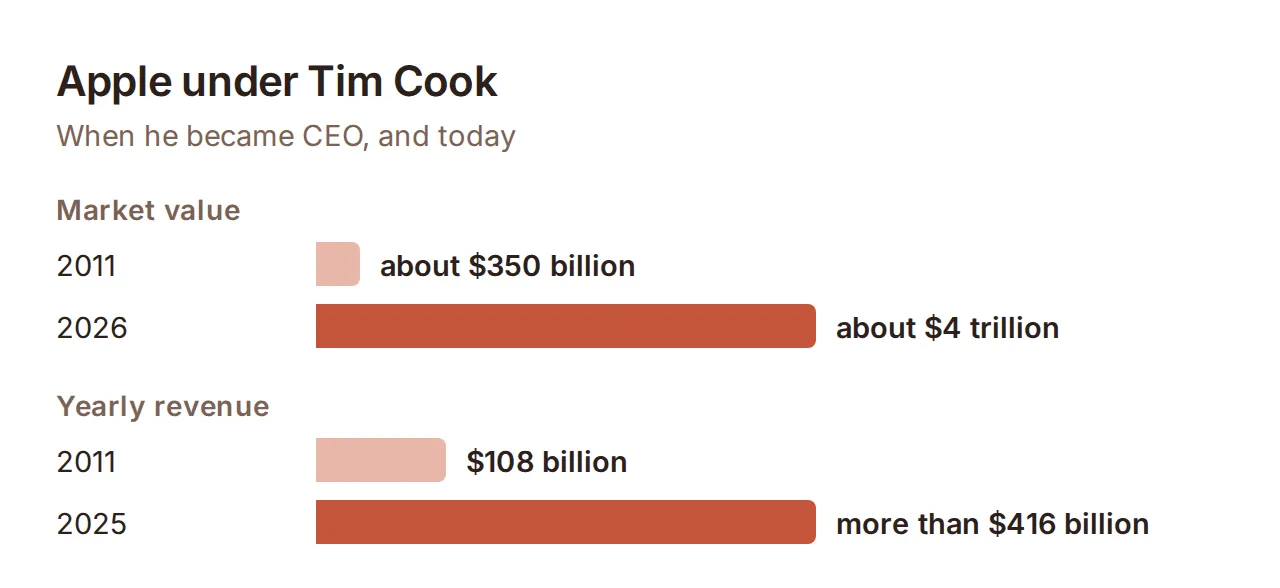
Here is what happened over the next fifteen years, in Apple’s own numbers:
- Apple’s market value grew from about $350 billion to about $4 trillion. Along the way, it became the first American company worth $1 trillion, in 2018.
- Yearly revenue nearly quadrupled, from $108 billion in 2011 to more than $416 billion in 2025.
- More than 2.5 billion Apple devices are in active use.
- Services, things like the App Store, iCloud and Apple Music, became a business of more than $100 billion a year.
And the products:
- Apple Watch (2015): Apple’s first completely new product category after Jobs. Today it is one of the most popular watches in the world.
- AirPods (2016): People laughed at them as “earrings”. Then everybody bought a pair.
- Apple silicon (2020): Apple dropped Intel and moved the Mac to its own chips. That turned the Mac from a nice but warm laptop into one with a battery that lasts all day, and it is a big reason the cheap MacBook Neo could exist this year.
- Vision Pro (2024): Impressive, heavy, expensive, and more of a beginning than a hit so far.
Cook also made Apple stand for things beyond products, most of all privacy. In 2016, the FBI wanted Apple to build a way into a locked iPhone that belonged to one of the attackers in a shooting in San Bernardino, California. Cook refused, and wrote an open letter to customers explaining why: a key built for one phone could end up opening everyone’s. Plenty of people, including politicians, thought he was wrong. I think he was right, and I think it took real courage to say no to the US government in public.
What did not go so well
Fifteen years is a long time, and not everything worked. The Apple car, worked on for about a decade, was quietly cancelled in 2024. And Apple was clearly late to the AI wave: the smarter Siri it showed in 2024 was delayed in 2025, at a time when every other company was shipping AI features every month.
Then there is the App Store. Apple takes a cut of up to 30% from many purchases made in apps, and developers and regulators in Europe and the US have fought it for years. Apple has had to change its rules in some places, but usually only as far as it was forced to. Here I think Cook’s Apple played it too safe, and protected a money machine a little too hard.
There is also a fair criticism I share, as a fan: Cook’s Apple became very good at improving things and a little less brave at inventing them. Every iPhone was better than the last. Very few things surprised us.
Cook’s goodbye
Alongside the announcement in April, Cook wrote a letter to Apple’s users. He said he reads customers’ emails every morning, and that “in every one of those emails I feel the beating heart of our shared humanity.” He described himself as “a person who grew up in a rural place in a different time and, for these magical moments, got to be the CEO of the greatest company in the world.”
You can be cynical about a CEO letter. I am not. It sounds exactly like him.
And he is not leaving. He stays on as executive chairman, and Apple says he will help with things like talking to governments around the world. In plain words: Ternus builds the products, Cook keeps handling the people in suits.
Why I am excited about John Ternus
Ternus joined Apple’s product design team in 2001, so he has been there for 25 years. He studied mechanical engineering at the University of Pennsylvania. Since 2021 he has run hardware engineering, which means the iPhone, the Mac, the iPad, AirPods and Apple Watch all went through his team. Recent work includes the iPhone Air and the MacBook Neo.
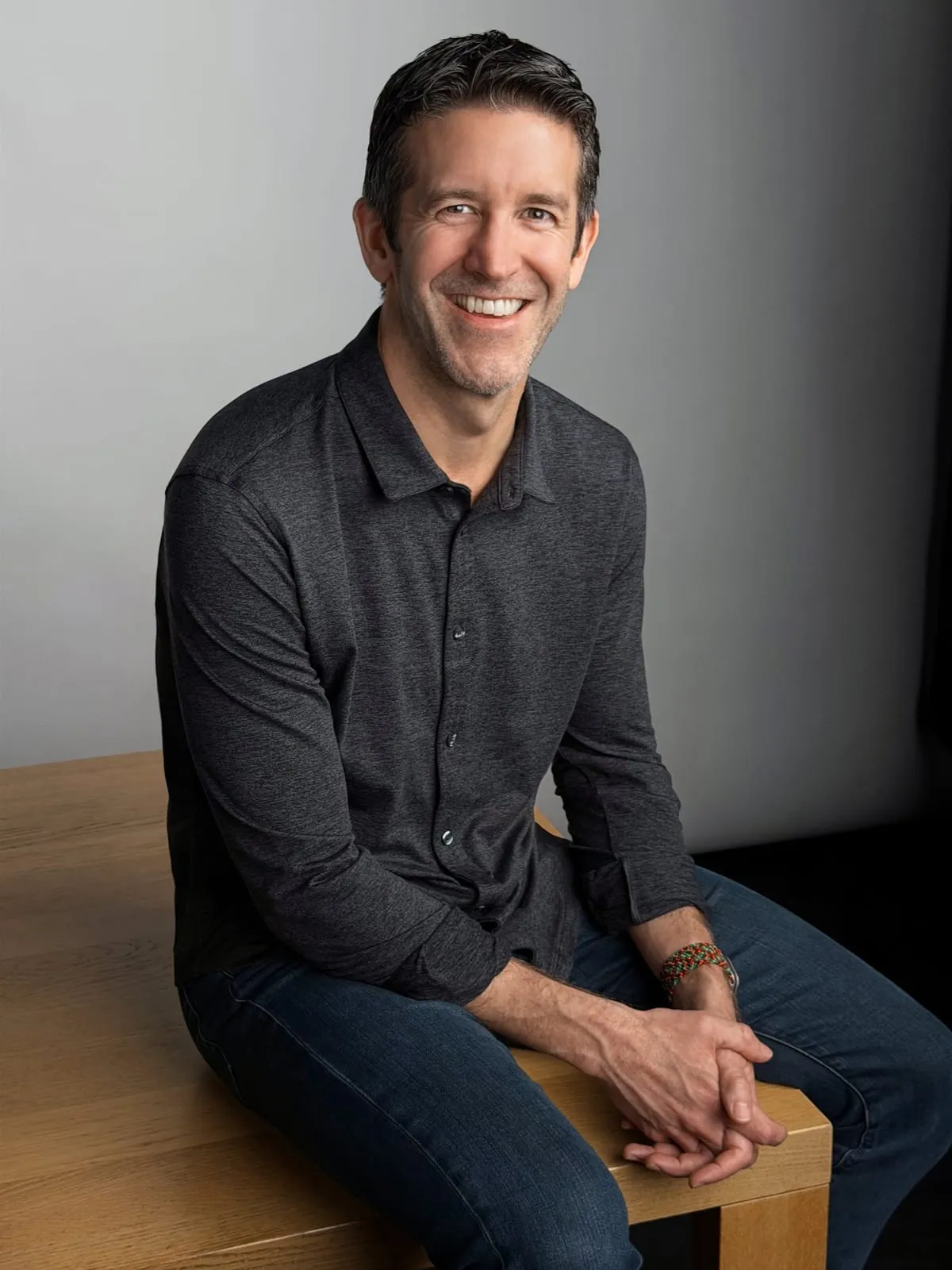
You may know him from Apple’s videos: the calm man explaining why a hinge or a cooling system was hard to build. He is a product person. Not in the same way Steve Jobs was, nobody is, but he has spent his whole career on the question Jobs cared about most: how should this thing look, feel and work in your hand?
As a mechanical engineer myself, I find that genuinely exciting. Apple was led by a product visionary, then by the best operations mind in the industry. Now, for the first time, it is led by someone whose whole career is making physical things work.
What I hope for is simple. Cook gave Apple stability, money and time. Ternus can use them to play again. To try strange ideas, to take risks that might not work, to surprise us the way the first iPhone did. The MacBook Neo already showed a bit of that: a cheap, colourful Mac that nobody expected Apple to make. I want more of that Apple.
Thank you, Tim
Most CEO changes are a crisis or a power struggle. This one was planned for years, announced months ahead, and handed to someone who has been inside the company for a quarter of a century. That is succession done properly, and very few companies manage it.
Steve Jobs built Apple twice. Tim Cook made sure it would last. Taking over from a legend, during the worst week imaginable, and then quietly running the company for fifteen years until it was worth more than ten times as much, is one of the great business stories of our time.
Next week’s iPhone event will be John Ternus’s first on stage as CEO. I will be watching, and probably looking at the hinges. But I will also miss hearing “good morning” from that calm voice from Alabama.
Thank you, Tim.