The phone that ate everything
· 5 min read
Fourteen years ago today, on 29 June 2007, the first iPhone went on sale in the United States. People queued outside shops for days. It cost $499 for 4 GB and $599 for 8 GB, it only worked with one carrier, and it could not even send a photo by text message.
It still changed almost everything.
What phones looked like before
If you had a “smart” phone in 2006, it was probably a BlackBerry or a Nokia. Half of the front was a plastic keyboard, the screen was small, and the internet was a stripped-down version of real websites. You browsed with arrow keys. Every button had one job, forever, whether you needed it or not.
Steve Ballmer, then the head of Microsoft, laughed at the iPhone in an interview and called it the most expensive phone in the world, one that business customers would not want because it had no keyboard. That sounded reasonable at the time. Most experts agreed with him.
Three devices, one phone
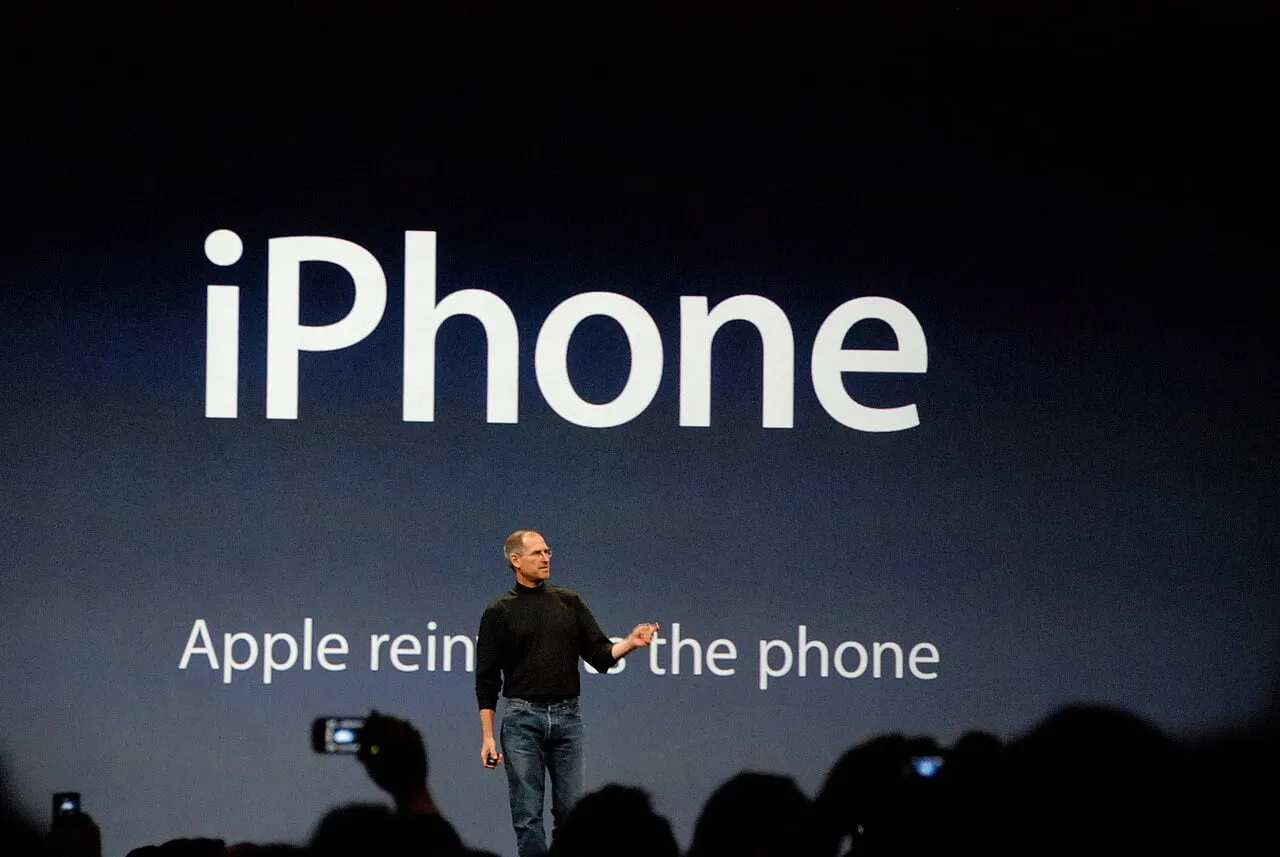
On 9 January 2007, Steve Jobs walked on stage at Macworld in San Francisco and said Apple was launching three products: a widescreen iPod with touch controls, a revolutionary mobile phone, and a breakthrough internet communicator. He repeated the list a few times until the audience understood. It was one device.
The trick was the glass. Instead of a keyboard that was always there, the iPhone had a 3.5-inch touchscreen that became whatever you needed. A keyboard when you typed, a number pad when you called, a full web page when you browsed. Software replaced hardware. That one decision is the reason your phone today can be a map, a bank, a camera or a boarding pass.
The part nobody planned: apps
The funny thing is that the first iPhone had no App Store. Jobs wanted developers to build web apps instead. Only a year later, in July 2008, Apple opened the App Store with about 500 apps.
That changed how software is made. Before, getting a program to people meant boxes in shops or downloads from a website most people did not trust. Suddenly a student in a dorm room could publish an app and reach millions of people the same week. Uber, Instagram and WhatsApp all exist because of that. So do whole jobs, like mobile developer or app designer, that hardly existed in 2007.
A good comparison: the remote control
Think of a TV remote with 50 buttons. You use five of them. The other 45 are there because someone, somewhere, might need them once. That was the phone before 2007.
The iPhone was like replacing the remote with a screen that only shows the buttons that make sense right now. Simple for the user, much harder for the people building it. And that is the real lesson for me: good products move the complexity away from the user and into the design.
What I think Steve Jobs got right
Jobs was famously hard to work with, and many brilliant people at Apple did the actual engineering. But a few of his ideas are worth learning from, especially for anyone who manages projects or products.
- Saying no. When Jobs returned to Apple in 1997, the company had a confusing list of products. He cut it down to a handful. Focus is not about what you do, it is about what you decide not to do.
- Hardware and software together. Apple designed the device and the software as one thing. That is why the touch felt right in 2007 when competitors’ touchscreens felt clumsy.
- Starting from the user. He did not ask what a phone should have. He asked what people were struggling with and worked backwards to the technology.
- Being willing to replace your own hit. The iPhone made the iPod, then Apple’s biggest product, less important. Most companies protect what already works. Apple competed with itself.
How it changed ordinary days
The easiest way to see the impact is to think about a normal day in 2005 and compare it with today.
- Getting somewhere new. Then: print directions at home, or ask strangers. Now: a blue dot shows exactly where you are.
- Taking a taxi. Then: call a company, wait, hope they come, pay in cash. Now: tap a button and watch the car arrive on a map.
- Photos. Then: a separate camera, a film or memory card, and photos shared weeks later. Now: billions of photos a day, shared in seconds.
- Work. Then: email waited until you were back at your desk. Now: work follows you everywhere, for better and worse.
None of these were in the first iPhone. But they all needed what it introduced: a big touchscreen, the real internet in your pocket and, a year later, apps.
The first version was far from perfect
It is easy to forget how much was missing in 2007:
- No apps from other companies, no copy and paste, no picture messages and no video recording.
- No fast mobile internet. It used the slow 2G network, while many rival phones already had 3G.
- One carrier. In the US it only worked with AT&T, on a two-year contract.
- A painful price cut. Just over two months after launch, Apple cut the 8 GB model from $599 to $399. Early buyers were so angry that Apple gave them a $100 store credit.
Not everything it changed was good
The iPhone also gave us something nobody planned for: a screen that is always with us. Notifications, endless feeds and the urge to check the phone every few minutes are side effects of the same idea that made it great. Companies learned that attention is valuable, and many apps are designed to keep us scrolling. The device that put the internet in our pocket also made it very hard to put the internet down.
Looking back from 2021
Today almost every phone looks like that first iPhone: a slab of glass with a few buttons on the side. Nokia sold its phone business and BlackBerry stopped making its own phones.
The first iPhone was slow, expensive and missing basic features. But it got the most important thing right: it changed the question from “what buttons should a phone have?” to “what should a phone be able to become?”. Fourteen years later, we are still answering that question.