Vaccines versus variants: the year the pandemic changed shape
· 5 min read
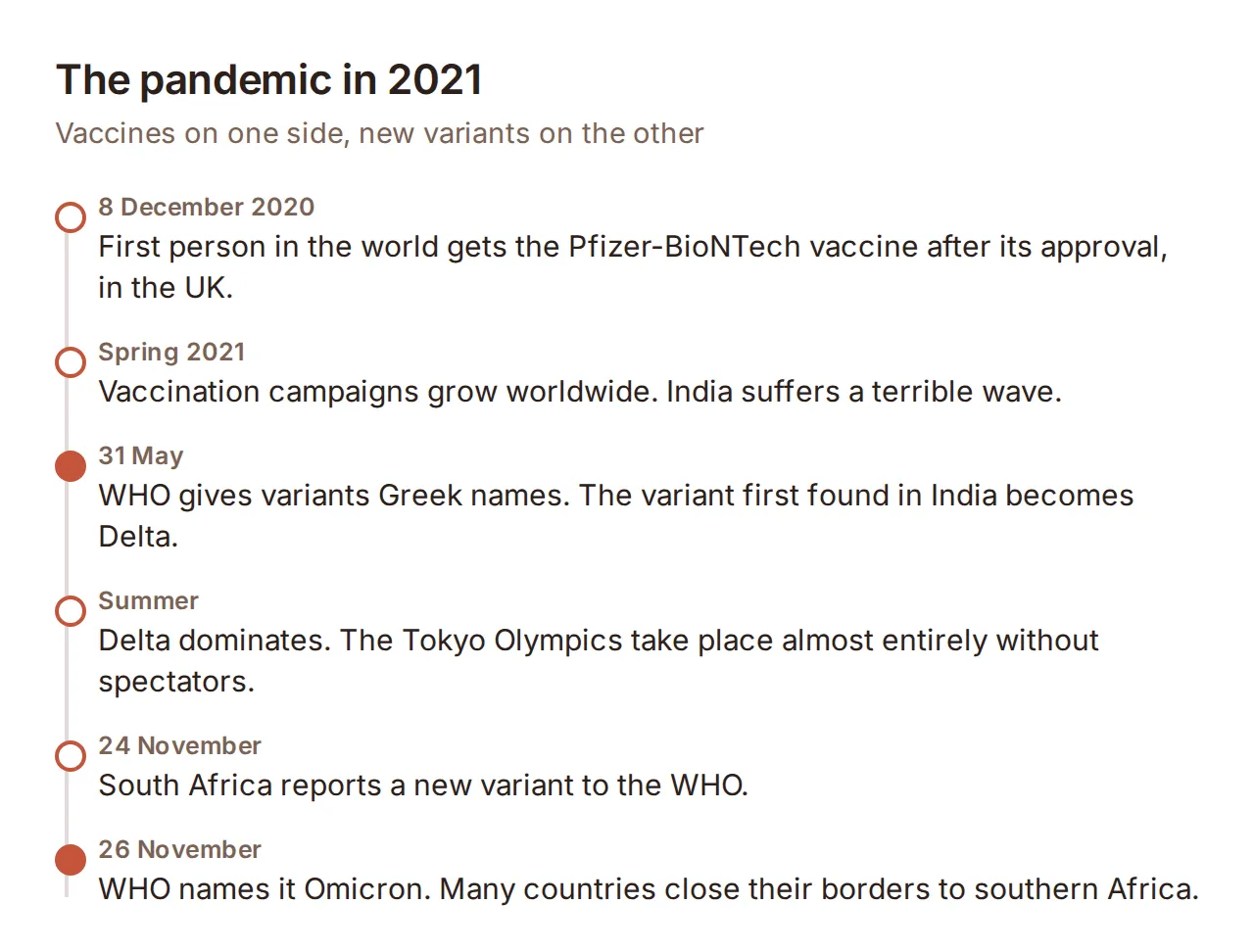
A year ago, the mood was cautiously hopeful. On 8 December 2020, a 90-year-old woman in the UK, Margaret Keenan, became the first person in the world to get the Pfizer-BioNTech vaccine after it was approved. BioNTech, by the way, is a German company from Mainz. The plan for 2021 seemed simple: vaccinate as many people as possible, and get back to normal.
It did not quite work out that way. 2021 became a race, with vaccines on one side and a virus that kept changing on the other.
The biggest vaccination campaign in history
The speed was astonishing. Vaccines usually take many years to develop. These took less than one. And then the world tried to give billions of doses in a single year.
In many countries, the rollout started with the oldest people and health workers, then moved down by age. Vaccination centres opened in sports halls, exhibition centres and even cathedrals. Booking a slot became a national sport, with people refreshing websites at midnight.
But the doses were not shared equally. Rich countries had ordered early and ordered a lot. By the end of the year, in high-income countries, roughly two in three people have had at least one dose. In low-income countries, it is closer to one in ten. In October, the World Health Organization set a goal of vaccinating 40% of every country’s population by the end of 2021. Many poorer countries are still far from it.
Delta: the faster one
Viruses change all the time, mostly in unimportant ways. But every now and then, a change helps the virus spread faster.
A new version was first detected in India in October 2020. In spring 2021, India went through a terrible wave, and that version spread around the world. At the end of May, the WHO introduced simpler names for variants, using the Greek alphabet, partly so that variants would stop being named after the countries where they were found. This one became Delta.
Delta spread much faster than the earlier versions, and by the summer it was dominant in most of the world. Vaccines still did a good job of preventing severe illness, but it became clear that vaccines alone would not simply make the virus disappear.
Life during the Delta wave was a strange mix. Many places reopened. The Tokyo Olympics, postponed from 2020, finally took place in the summer, almost entirely without spectators in the stands. Offices tried hybrid work. Travel came back slowly, with forms, tests and certificates for every border.
Omicron: the surprise in November
Just as Delta seemed to be the main story of the year, scientists in South Africa and Botswana noticed something new. On 24 November, South Africa reported a new variant to the WHO. Two days later, the WHO named it Omicron.
If you were counting Greek letters, you might have noticed that it skipped two. After Mu came Nu and Xi. The WHO skipped Nu because it sounds too much like “new”, and Xi because it is a common surname.
Omicron had around 50 changes compared to the original virus, about 30 of them in the spike protein, the part the virus uses to get into our cells and the part our vaccines train the body to recognise. That is far more than any variant before.
Many countries closed their borders to southern Africa on the same day the WHO announced it, even though the variant had probably already spread elsewhere. Scientists in South Africa had done exactly what you would hope: they found something worrying and told the world immediately. South Africa’s government said that “excellent science should be applauded and not punished”.
Omicron is spreading extremely fast, and many countries have shortened the gap before booster shots to give more people extra protection quickly. As I write this, it is still too early to know exactly how this wave will end.
How the year changed daily life
Beyond the medical side, 2021 changed how many of us live and work.
Working from home went from emergency to normal. Many companies found that a lot of work could be done from anywhere, and many people discovered they did not miss the daily commute. Video calls became so normal that “you’re on mute” is now the most said sentence of the decade.
Travel became paperwork. Test certificates, vaccine passes, entry forms, QR codes for restaurants. Many of us now carry our health status in an app.
And the pandemic shaped politics everywhere. Arguments about lockdowns, vaccine passes and mandates dominated the news in many countries.
What I think
What stays with me from this year is how fast science moved, and how much slower everything else was.
Scientists developed vaccines in under a year, tracked new variants almost in real time, and shared their data with the whole world. That is remarkable. But getting vaccines to everyone, agreeing on rules and keeping the public on board turned out to be much harder than making the vaccine itself.
In projects, we often think the technical part is the hard part. Usually, the technical part is only the beginning. The real work is getting the solution to everyone who needs it, in time, and convincing them to use it.
And I think the vaccine gap was not only unfair, it was short-sighted. In August, the head of the WHO asked rich countries to pause booster shots until more people in poorer countries had had a first dose. Most of them carried on anyway. I understand why, every government wants to protect its own people first. But a virus that spreads freely somewhere has more chances to change, and Omicron was a reminder that a new variant found anywhere soon becomes everyone’s problem.
I hope 2022 is the year the virus finally becomes a normal part of life, rather than the thing that decides our lives. But after this year, I have learned to be careful with predictions.
Sources
- WHO: Simple, easy-to-say labels for SARS-CoV-2 variants (May 2021) ↗who.int
- WHO: Classification of Omicron (B.1.1.529) as a variant of concern (November 2021) ↗who.int
- NHS England: Landmark moment as first NHS patient receives COVID-19 vaccination (December 2020) ↗england.nhs.uk
- KFF: Tracking global COVID-19 vaccine equity ↗kff.org