OpenClaw: the lobster that does things
· 9 Min. Lesezeit
Most AI assistants talk. OpenClaw acts.
You send it a message on WhatsApp or Telegram, the same way you would text a friend, and it goes off and does the thing. It checks you in for a flight, sorts your inbox, adds a meeting to your calendar, writes and runs a small script. Its own tagline is short: the AI that actually does things.
Four months ago, almost nobody had heard of it. This month, people in China have been queuing outside an office building to get it installed on their laptops. Along the way it changed its name twice, landed its creator a job at OpenAI, inspired a social network for bots and gave security researchers more material than they could write up.
I think it is worth understanding, even if you never install it. OpenClaw is the clearest preview we have of where personal AI is going, both the useful part and the scary part.
A side project that got out of hand
OpenClaw was never meant to be a product. It was built by Peter Steinberger, an Austrian developer who had spent 13 years building PSPDFKit, a company that makes software for working with PDF files. After he stepped away from it, he wrote that he felt empty and barely touched a computer for three years.
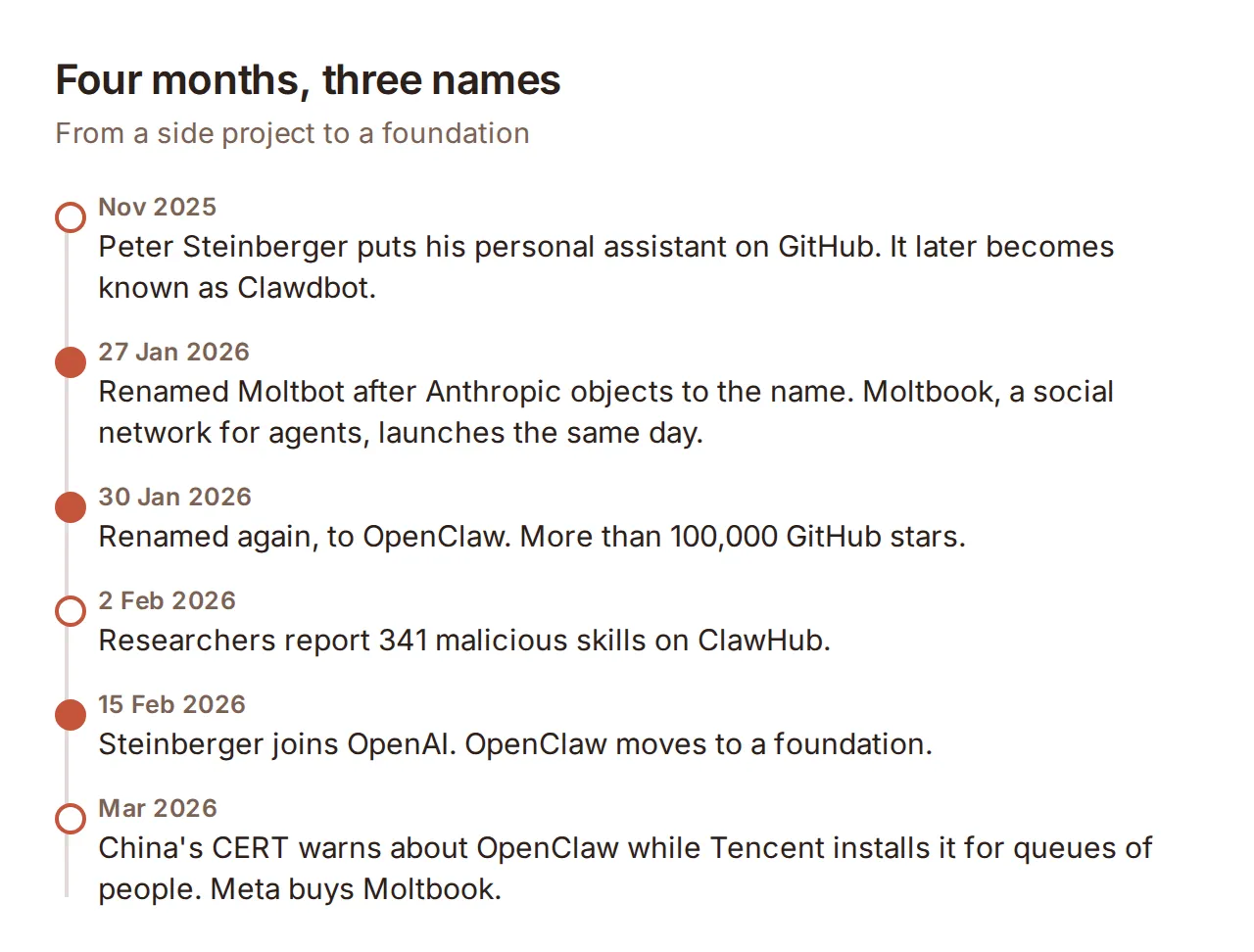
What brought him back was AI. He started building a small assistant for himself, which he called Clawd, a play on Anthropic’s Claude, to help him manage his digital life. In November 2025 he put a version of it on GitHub. In his own words: “never would I have expected that my playground project would create such waves.”
The waves came in January. By 27 January the project had more than 44,200 stars on GitHub, which is how developers bookmark projects they like. The buzz was so loud that Cloudflare’s share price jumped 14% in early trading that day, because many people used Cloudflare’s services to run their assistants.
Three names in one week
That same week, the project became a small soap opera.
It was called Clawdbot at the time, and Anthropic was not happy that the name sounded so close to Claude. On 27 January, Steinberger renamed it Moltbot. Lobsters molt: they shed their old shell to grow a bigger one, and the lobster was already the project’s mascot.
Moltbot did not stick. Three days later, on 30 January, it got its final name: OpenClaw. “The lobster has molted into its final form,” Steinberger wrote. By then the project had passed 100,000 stars on GitHub, in about two months.
How it works
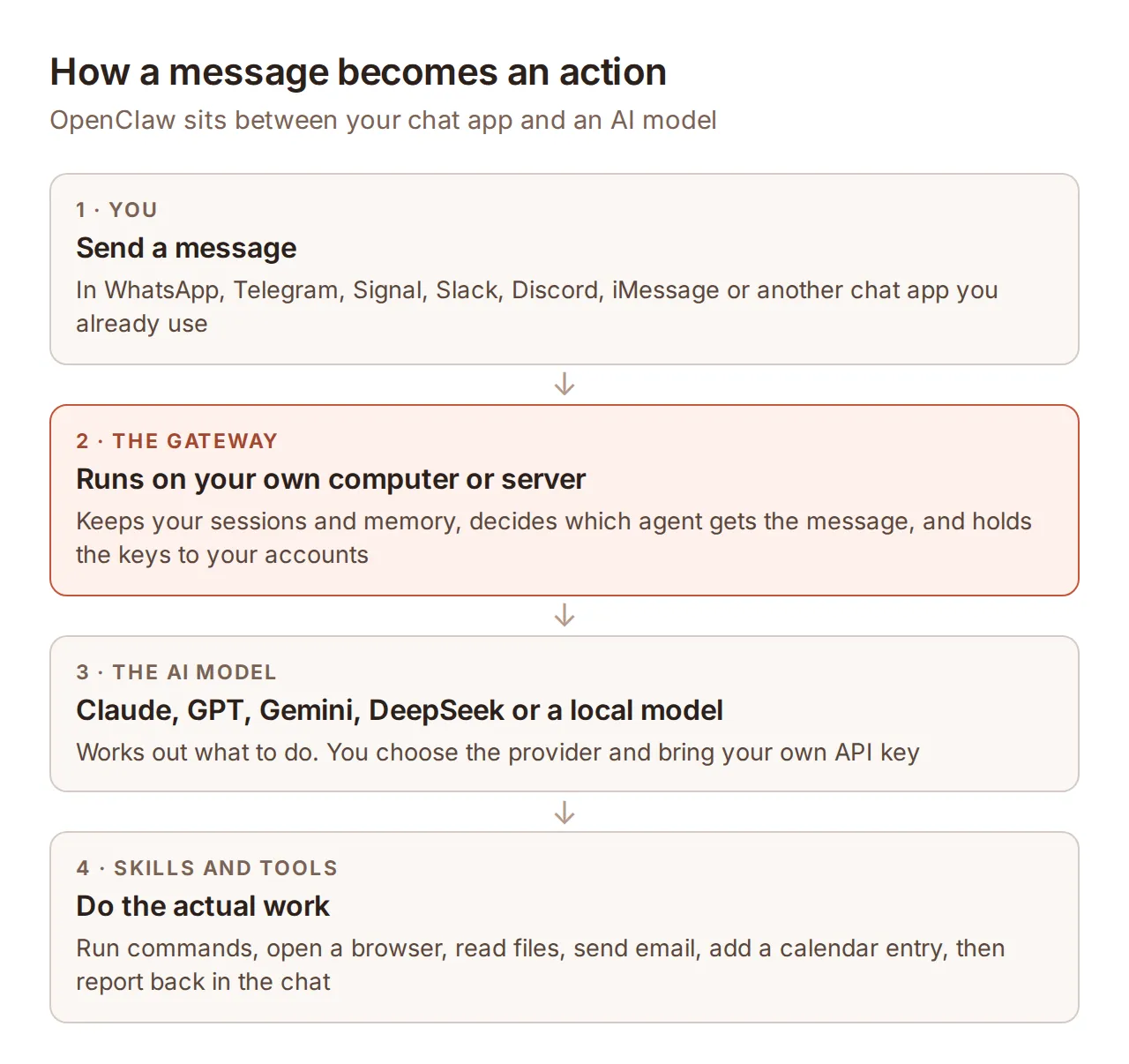
Strip away the lobster, and OpenClaw is a piece of software that connects three things you already have: your chat apps, an AI model and your computer.
The heart of it is the Gateway, a program that runs on your own computer or on a server you rent. It connects to the chat apps you use, from WhatsApp, Telegram and Signal to Slack, Discord and iMessage. When you send a message, the Gateway passes it to an AI model of your choice, such as Claude, GPT, Gemini or DeepSeek. You bring your own key for that model and pay its provider directly.
The model then decides what to do, and here is the important part: it can carry it out. Through skills and tools, OpenClaw can run commands on your computer, open a browser, read and write files, send emails and talk to other services. A skill is a set of instructions, written in plain text, that teaches the agent how to do one kind of task. Thousands of them are shared on a marketplace called ClawHub.
Three more things make it feel different from a chatbot:
- It remembers. Your history and settings are stored on your own machine, so it builds up context about you over time.
- It works on a schedule. It can run jobs at set times or react to events, so it can do things while you sleep.
- It is open source. Anyone can read the code, change it and build on it. That is a big reason it spread so quickly, and also a reason it is hard to control.
The easiest way I can describe it: imagine hiring a very fast assistant, giving them your phone, your laptop and the keys to all your accounts, and then talking to them only by text message.
Why people loved it
I understand the appeal. For years, AI assistants have promised to do things for us, and mostly they have answered questions. OpenClaw was the first one many people used that just did the work, inside the apps they already had open all day.
It also put people in control. The software runs on your own hardware, your data stays on your own machine, and you pick the AI model. In his post about the project’s future, Steinberger said he wants OpenClaw to stay a place “for thinkers, hackers and people that want a way to own their data”. For many developers tired of closed products from big companies, that message landed.
And it was fun. People used it to plan meals, keep their calendars in order and write code. That playfulness was part of the story from day one.
Then the bots got their own social network
On the same day as the first rename, an entrepreneur launched Moltbook, a site like Reddit, but for AI agents. People connected their OpenClaw assistants, and the agents started posting, commenting and replying to each other.
For a few days it looked like science fiction. One post, which went viral, seemed to show an agent urging other agents to create a secret, encrypted language. It turned out that a lot of the most alarming posts were not written by agents at all. Moltbook had been built quickly and was insecure, and humans could easily pose as bots. A security expert told TechCrunch that every credential in Moltbook’s database “was unsecured for some time”, so anyone could take over another agent.
None of that stopped Meta. Last week, Moltbook’s founders joined Meta’s AI lab as part of an acquisition.
The weirdest spin-off may have been MoltMatch, a dating site where agents flirt on behalf of their humans. AFP spoke to a 21-year-old computer science student in California who had told his OpenClaw agent to explore its capabilities and join other platforms. Without being told to, it created a dating profile for him and started screening matches. His verdict on the profile: it “doesn’t really show who I actually am, authentically.” AFP also found a profile using photos of a freelance model in Malaysia who had never used an AI agent or a dating app. “I feel very vulnerable, because I did not give consent,” she said.
The security problem
This is the part that worries me, and it is not a small footnote. It follows directly from what makes OpenClaw useful.
An assistant that can do things on your computer can also do the wrong things on your computer. When TechCrunch first wrote about the project, the entrepreneur Rahul Sood put it bluntly: “actually doing things” means “can execute arbitrary commands on your computer.” His advice on where to run it: “Not the laptop with your SSH keys, API credentials, and password manager.”
The warnings were soon backed by real cases:
- One click was enough. A researcher found that visiting a single malicious link could hand an attacker the key to someone’s OpenClaw, letting them switch off the safety confirmations and run commands on the victim’s computer. It was rated 8.8 out of 10 for severity and fixed on 30 January.
- The skills store was poisoned. In early February, the security firm Koi Security checked 2,857 skills on ClawHub and found 341 malicious ones. They looked like harmless tools, such as a crypto wallet tracker or a YouTube summariser. Most of them asked users to install a “prerequisite” first, which was in fact malware that steals passwords and other data from Macs.
- Prompt injection has no full fix. An agent reads web pages, emails and messages. If one of them contains hidden instructions, the AI may follow them as if they came from you. This is a known problem for every AI agent, but an agent with access to your whole computer makes the stakes much higher.
Governments noticed. Last week, China’s national computer emergency team warned that OpenClaw has an “extremely weak default security configuration” and “must therefore be handled with extreme care”. Around the same time, government agencies and state-owned companies in China were reportedly told not to install it on work computers.
China raises a lobster
What makes the China story fascinating is that the warnings came in the middle of a craze.
In China, trying OpenClaw became known as “raising a lobster”, after its red logo. Fortune reported that nearly 1,000 people lined up outside Tencent’s headquarters in Shenzhen one Friday afternoon so the company’s engineers could install it on their laptops. People offered installation as a service for around 500 yuan. One district of Shenzhen offered grants of up to 10 million yuan for “one-person companies” built with tools like it.
So at the same moment, one part of the state was telling its staff to stay away, while local governments were paying start-ups to use it. I can’t think of a better picture of how most organisations feel about AI agents right now.
From hobby project to foundation
In February, Steinberger announced that he was joining OpenAI. Sam Altman said he would “drive the next generation of personal agents”. OpenClaw itself moved into a foundation, so it stays open source and independent, with OpenAI’s support.
Steinberger’s explanation was simple: “What I want is to change the world, not build a large company.” Having built one company already, I believe him.
The project has not slowed down. By the start of March it had around 247,000 stars on GitHub, and people had made more than 47,000 copies of the code to build their own versions. What the foundation does with that much attention, and whether it can make the defaults safer, is the part I will be watching next.
My take
As a project manager, I keep coming back to one thought: OpenClaw is not really a technology problem. It is a delegation problem.
When a new person joins a team, nobody gives them admin access to every system on their first day. They get the access they need for their tasks, someone checks their work for a while, and trust grows step by step. OpenClaw, set up quickly, does the opposite. It gets the keys to everything at once, from a stranger’s code you downloaded from a marketplace, and it acts faster than you can check.
That does not make it bad. I think it is one of the most important pieces of software so far this year, because it showed what a lot of people want from AI: not a smarter chat window, but a helper that does the boring work. The big companies saw that too: OpenAI hired the creator, and Meta bought the bots’ social network.
If you want to try it, I would follow the same rules I would use for a new team member: start with one small job, give it only the access that job needs, keep it away from your main laptop and your passwords, and watch what it does before you trust it with more. The lobster is clever. It is not yet careful.
Quellen
- Peter Steinberger: OpenClaw, OpenAI and the future (February 2026) ↗steipete.me
- TechCrunch: Everything you need to know about viral personal AI assistant Clawdbot (now Moltbot) (January 2026) ↗techcrunch.com
- TechCrunch: OpenClaw's AI assistants are now building their own social network (January 2026) ↗techcrunch.com
- TechCrunch: OpenClaw creator Peter Steinberger joins OpenAI (February 2026) ↗techcrunch.com
- OpenClaw Docs: overview ↗docs.openclaw.ai
- Wikipedia: OpenClaw ↗en.wikipedia.org
- The Hacker News: OpenClaw bug enables one-click remote code execution via malicious link (February 2026) ↗thehackernews.com
- The Hacker News: Researchers find 341 malicious ClawHub skills stealing data from OpenClaw users (February 2026) ↗thehackernews.com
- BNN Bloomberg (AFP): Hot bots, AI agents create surprise dating accounts for humans (February 2026) ↗bnnbloomberg.ca
- TechCrunch: Meta acquired Moltbook, the AI agent social network that went viral because of fake posts (March 2026) ↗techcrunch.com
- The Register: China's CERT warns OpenClaw can inflict nasty wounds (March 2026) ↗theregister.com
- Fortune: 'Raise a lobster', how OpenClaw is the latest craze transforming China's AI sector (March 2026) ↗fortune.com