CrowdStrike: one update, 8.5 million blue screens
· 5 min read
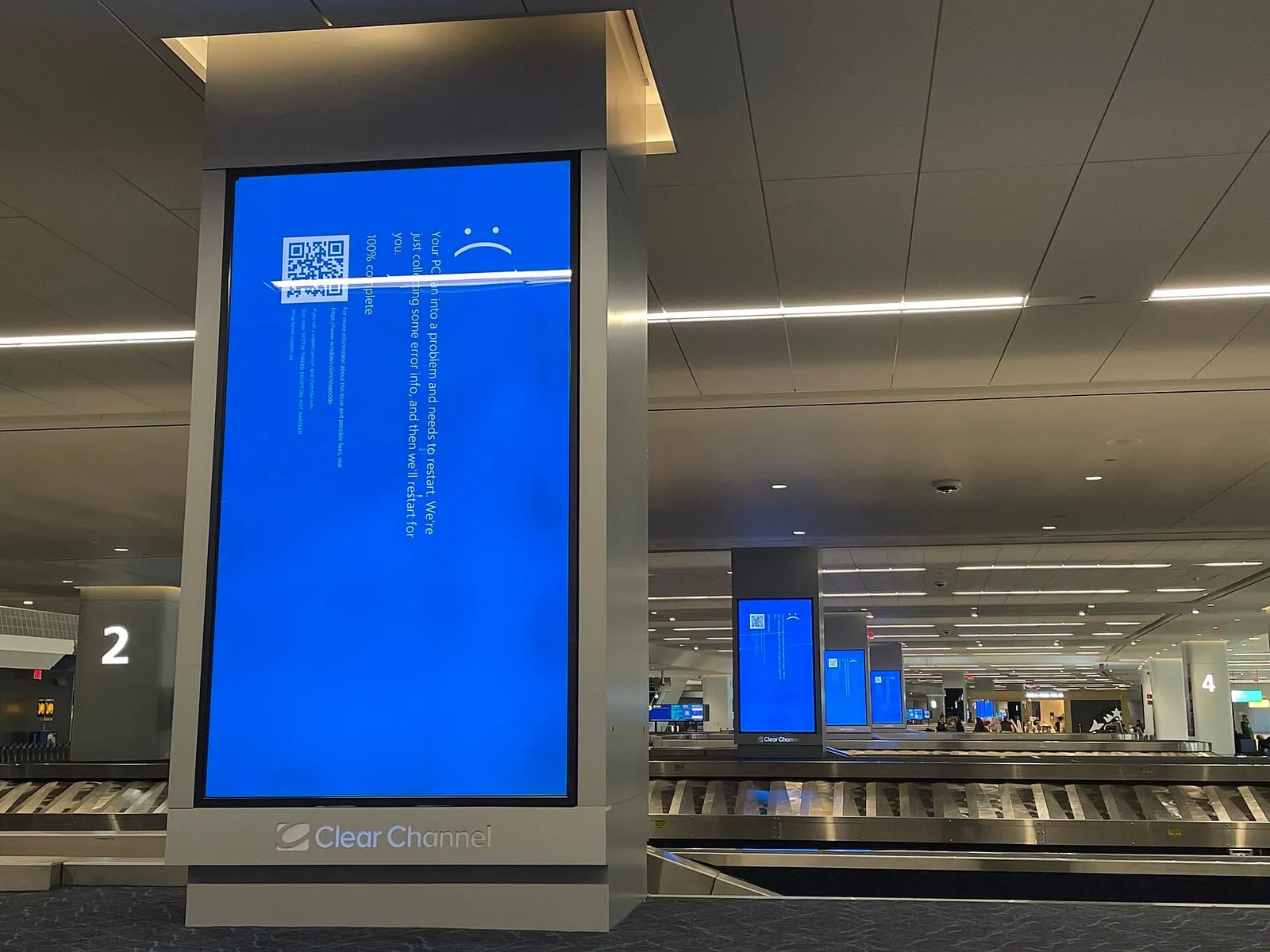
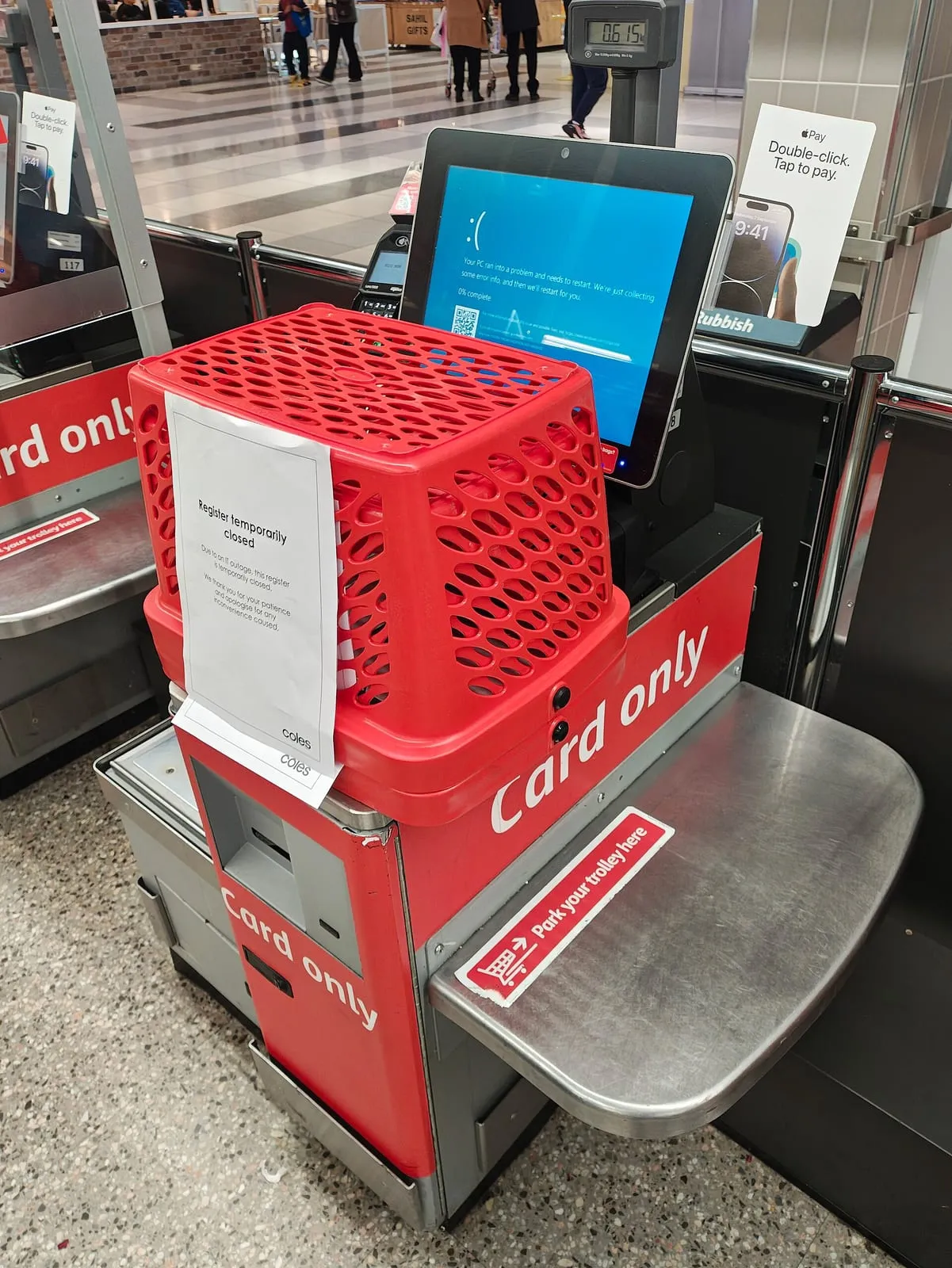
Friday, 19 July, should have been a normal summer Friday. Instead, people woke up to airports with handwritten departure boards, supermarkets with dead tills, and Sky News unable to broadcast live. All over the world, Windows computers were showing the same thing: the blue screen of death. And when people restarted them, they showed it again.
This was not a cyberattack. It was a software update from a company whose whole job is protecting computers from cyberattacks.
What is CrowdStrike?
CrowdStrike makes security software for companies. Its main product, Falcon, sits on computers and servers and watches for attackers. If you work at a large company, there is a decent chance it is running on your work laptop right now without you knowing.
To catch attackers, Falcon needs to see everything happening on the computer. So it runs very deep inside Windows, in what is called the kernel. The kernel is the core of the operating system, the part that talks directly to the hardware.
A normal app that crashes just closes. If something in the kernel crashes, the whole computer goes down. That is why Windows shows the blue screen: it stops everything, to avoid doing something worse.
One file, 78 minutes
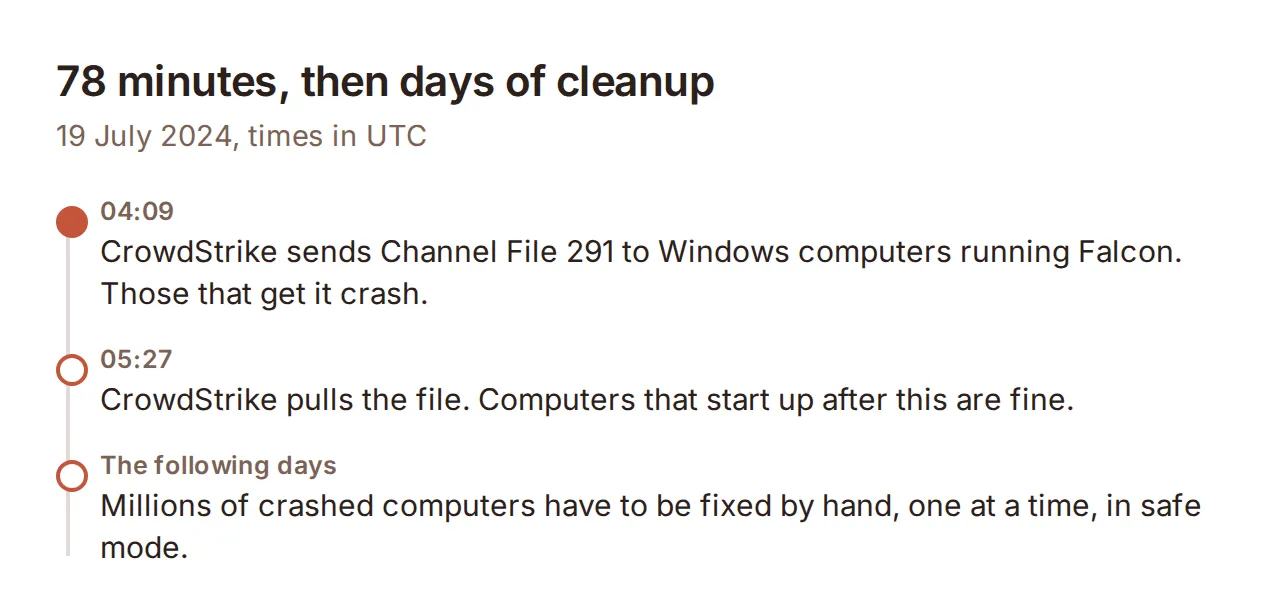
CrowdStrike updates Falcon’s knowledge of new attack techniques several times a day, through small configuration files. At 04:09 UTC on 19 July, it sent one of these, called Channel File 291.
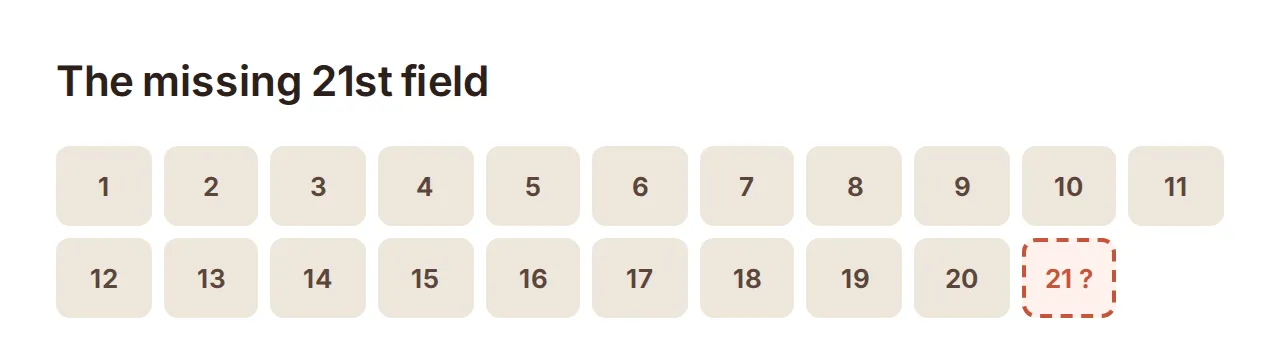
The file had a problem. CrowdStrike’s later analysis explained it in a slightly unbelievable way: the new instructions expected 21 pieces of information, but the software only provided 20. When Falcon tried to read the 21st, it reached for memory that was not there. In the kernel, that means a crash.
And a check that should have caught the faulty file before it was sent out had its own bug, so it let the file through.
At 05:27 UTC, 78 minutes later, CrowdStrike pulled the update. But by then, every Windows computer that had been switched on and connected had already received it.
Why it was so hard to fix
Here is the cruel part. Normally, a bad update is fixed with a good update. But these computers crashed while starting up, before they could download anything. They were stuck in a loop: start, crash, restart, crash.
The fix was simple and painful: someone had to go to each computer, start it in safe mode and delete the faulty file by hand. One computer at a time.
Many companies also encrypt their computers’ disks with BitLocker. To get into safe mode, you need a long recovery key for each machine. Those keys are usually stored on a server. Sometimes the server holding the keys was itself showing a blue screen.
So IT teams spent their weekend walking from desk to desk, airport counter to airport counter, typing 48-digit codes. Some machines came back after many restarts. Some took days.
How big was it?
Microsoft estimated that 8.5 million Windows devices were affected. That is less than 1% of all Windows computers. But they were the wrong 1%: the computers inside airlines, banks, hospitals and broadcasters, the ones that run things.
- More than 5,000 flights were cancelled worldwide that day.
- Delta Air Lines was hit hardest. Its crew scheduling system could not cope, and it cancelled about 7,000 flights over several days. Delta says the outage cost it around half a billion dollars.
- Hospitals postponed operations, emergency phone lines went down in some places, and payment systems failed.
- The insurer Parametrix estimated the losses for the 500 largest US companies alone, not counting Microsoft, at about $5.4 billion.
It has been called the largest IT outage in history, and it is hard to argue.
The apology
CrowdStrike’s CEO, George Kurtz, apologised quickly and plainly. He said the company was “deeply sorry for the impact that we’ve caused to customers, to travellers, to anyone affected by this.”
Then CrowdStrike sent some of the partners who helped clean up a thank-you gift: a $10 Uber Eats voucher. After a weekend of fixing thousands of computers by hand, that went about as well as you would expect. To be fair, CrowdStrike got the apology itself right. The gift card just made it look very small.
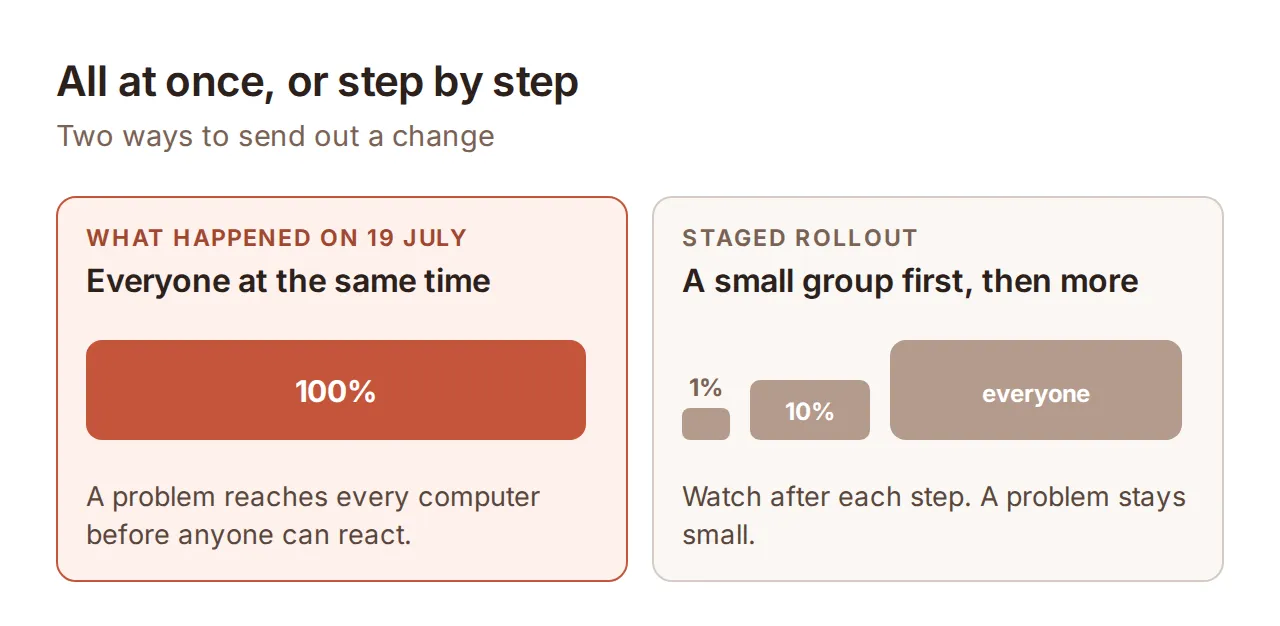
CrowdStrike has promised changes. The most important one is that future updates will be rolled out gradually, first to a small group of computers, then to more, instead of to everyone at once. Customers will also get more control over when they receive updates.
What I think
What strikes me is that nothing exotic happened. A file expected 21 things and got 20. A check that should have caught it did not. And the update went to everyone at the same time.
The last point is the real lesson. Big software companies have long rolled out risky changes slowly: first to 1%, watch, then 10%, watch, then everyone. CrowdStrike did that for its main software, but treated these small configuration files as routine, and sent them everywhere at once. Routine is exactly when people stop checking.
In project management, there is a version of this too. The big, scary milestones get reviews, sign-offs and risk meetings. The small, routine tasks just happen. And then one of them quietly turns out to be on the critical path for everything.
Then there is the kernel question, which I find the most interesting debate after this outage. Should security software be allowed that deep inside an operating system at all? Apple decided years ago that it should not, at least on the Mac: since 2019, it has pushed security tools out of the kernel into a safer layer, where a crash takes down the tool and not the whole computer. Microsoft says it cannot simply do the same on Windows, partly because of an agreement with the European Commission from 2009 that requires it to give security companies the same deep access its own products have. I suspect we will hear a lot more about this, and I would not be surprised if Windows moves closer to Apple’s approach.
There is also a bigger question about how much of the world runs on very few pieces of software. One security tool, on one operating system, stopped flights on several continents. That is a lot of eggs in one basket. We are very good at making that basket faster and cheaper. We are less good at asking what happens when someone drops it.
Sources
- CrowdStrike: Falcon content update, preliminary post incident report (July 2024) ↗crowdstrike.com
- CrowdStrike: Channel File 291 Root Cause Analysis (August 2024) ↗crowdstrike.com
- Microsoft: Helping our customers through the CrowdStrike outage (July 2024) ↗blogs.microsoft.com
- TechCrunch: Microsoft says 8.5M Windows devices were affected (July 2024) ↗techcrunch.com